
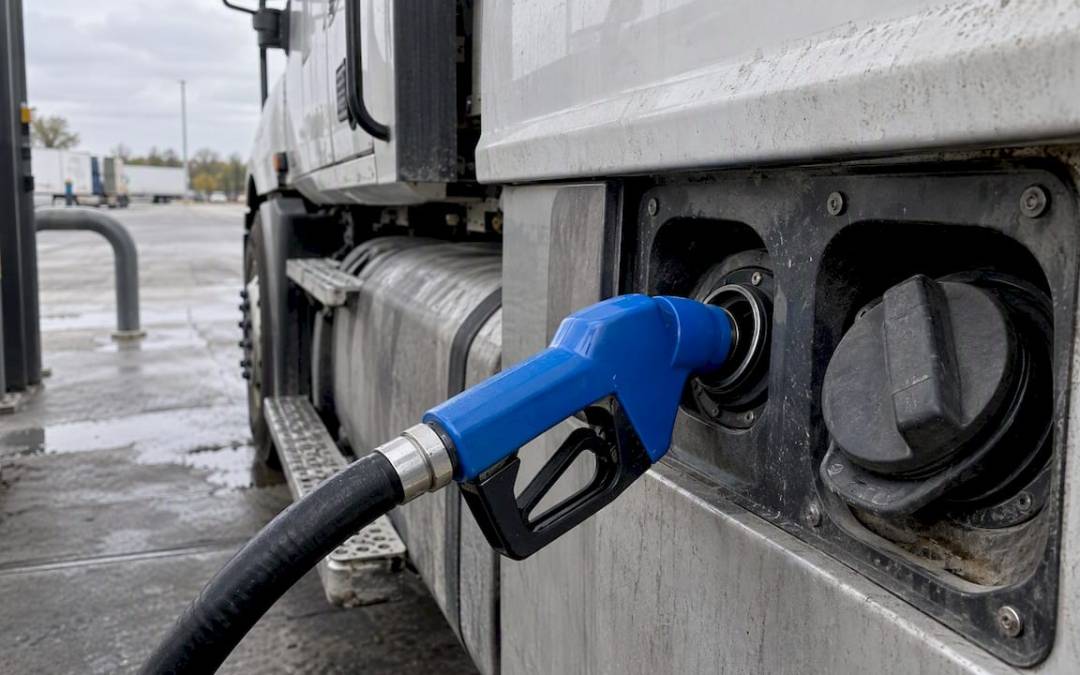
Use this formula: DEF gallons = diesel gallons × dose rate as a decimal. Your real rate shifts with engine design and duty cycle, so a short baseline test replaces the estimate with your own measured number.
TL;DR:
- Plan on 3% to 4% for typical use; move toward 5% for heavy towing, hills, hot, dry sites, and verify rates below 3% with testing.
- Group trucks by engine and duty cycle, log every fuel and DEF fill over representative conditions, then divide total DEF by diesel consumed.
- At 6 MPG, a 3% dose rate uses about 5 gallons of DEF per 1,000 miles; multiply that figure by ten for 10,000 miles.
- Keep a 20% to 50% inventory buffer, choosing more for remote sites or long lead times; an empty DEF tank can trigger roughly 50% power derating.
Table of Contents
- How do you calculate DEF from fuel volume or miles?
- What percentage of diesel should you plan for?
- How much DEF does a truck use per mile and per year?
- Why does DEF usage vary between trucks and sites?
- How can you measure your fleet’s real DEF dose rate?
- How do you turn usage into an order and delivery plan?
- Ready to size an order or schedule delivery?
- FAQ
- Sources
How do you calculate DEF from fuel volume or miles?
Two formulas cover nearly every planning job. The first starts with fuel burned. The second starts with miles driven.
Formula A: DEF from diesel gallons. Multiply the diesel you burned by your dose rate written as a decimal. Equipment World’s practitioner guidance uses 0.03 as a practical starting multiplier while noting that manufacturer ranges vary. Here is what that looks like for 1,000 gallons of diesel:
- At 2%: 1,000 × 0.02 = 20 gallons of DEF
- At 3%: 1,000 × 0.03 = 30 gallons of DEF
- At 4%: 1,000 × 0.04 = 40 gallons of DEF
- At 5%: 1,000 × 0.05 = 50 gallons of DEF
Formula B: DEF per mile. Divide your dose rate by your miles per gallon.
| MPG | DEF per mile at 2% | DEF per mile at 3% | DEF per mile at 4% |
|---|---|---|---|
| 5 | 0.004 gallons | 0.006 gallons | 0.008 gallons |
| 6 | about 0.0033 gallons | 0.005 gallons | about 0.0067 gallons |
| 7 | about 0.0029 gallons | about 0.0043 gallons | about 0.0057 gallons |
| 8 | 0.0025 gallons | 0.00375 gallons | 0.005 gallons |
Step-by-step worked example
Say a single truck burns 1,500 gallons of diesel a year at 6 MPG. These inputs are illustrative, so swap in your own.
- Find annual miles: 1,500 gallons × 6 MPG = 9,000 miles.
- Pick a dose rate: start at 3%, or 0.03.
- Multiply fuel by the rate: 1,500 × 0.03 = 45 gallons of DEF per year.
- Check it with Formula B: 9,000 miles × 0.005 gallons per mile = 45 gallons. Both routes land on the same number.
- Divide by 12 for a monthly figure: 45 ÷ 12 = 3.75 gallons of DEF per month.
A 45-gallon spread between the low and high ends is why one truck’s number should never be copied blindly to another.
Where the 3% default comes from
Cummins guidance for industrial applications describes DEF as 32.5% urea and 67.5% deionized water and advises planning with consumption around 3%–5% depending on environment and duty cycle.
For regulators, the same relationship matters in the other direction. The EPA’s draft technical support document scales DEF dose rates to the level of NOx reduction and converts those reductions into gallons of DEF consumed for its cost estimates. In plain terms, the harder the system works to cut NOx, the more DEF it uses.

Skip the spreadsheet
If you would rather not build the math yourself, our DEF calculator converts fuel or mileage into DEF quantities. For a longer walk through the diesel-to-DEF conversion, see our fleet manager’s guide to DEF consumption per diesel gallon.
What percentage of diesel should you plan for?
Manufacturer-oriented materials put the typical average at roughly 3%–4% by volume, with engine operation, duty cycle, terrain, and load driving the variation.
Pro Tip: Pick one planning percentage per equipment class, record it, and revise it only when your measured data says to.
Cummins advises planning with DEF consumption of 3%–5% depending on environment and duty cycle.
The spread comes mostly from how the engine meets its emissions targets. Equipment World explains that engines with higher exhaust gas recirculation (EGR) need less DEF, while SCR-only designs consume more DEF but may gain fuel efficiency. That is why two trucks with similar loads can show different rates.
Here is how we suggest choosing a number:
- Plan at 3% for newer on-highway tractors running steady highway miles in moderate weather, or when you have no data yet.
- Plan at 4% for mixed duty, regional hauling with frequent stops, or equipment that spends time under load.
- Plan at 5% for heavy towing, hilly terrain, hot and dry operating conditions, or SCR-heavy engine calibrations.
- Drop below 3% only after a baseline test shows your engines consistently run lower.
Running short on DEF risks a derate, while carrying a little extra costs only storage space.
How much DEF does a truck use per mile and per year?
This section gives you numbers to copy straight from an odometer and an MPG figure. All values below follow Formula B and assume the stated MPG and dose rate.
DEF per 1,000 miles:
- At 5 MPG: 8 gallons at 4%, 6 gallons at 3%, 4 gallons at 2%
- At 6 MPG: about 6.7 gallons at 4%, 5 gallons at 3%, about 3.3 gallons at 2%
- At 7 MPG: about 5.7 gallons at 4%, about 4.3 gallons at 3%, about 2.9 gallons at 2%
- At 8 MPG: 5 gallons at 4%, 3.75 gallons at 3%, 2.5 gallons at 2%
Scaling to 10,000 miles: multiply any figure above by ten.
Across ten trucks, annual use is about 5,000 gallons. The planning percentage alone moves the annual total by more than 3,000 gallons.
A practical forecast looks like this: read the odometer, divide miles since the last fill by MPG to get diesel burned, multiply by your rate, and you have the DEF used. Compare that to what you pumped and you have a check on your assumption as well.

Pro Tip: Log odometer and MPG at every DEF fill, then forecast the next delivery date by dividing your on-hand gallons by your average DEF gallons per day.
For semi-truck-specific numbers, our semi truck DEF consumption planning guide goes deeper, and our mileage-to-DEF dosing walk-through shows more MPG conversions.
Why does DEF usage vary between trucks and sites?
A static percentage is a starting point. Equipment World notes that consumption depends heavily on duty cycle, terrain, and climate, and that manufacturer rates are broad estimates. These are the main drivers:
- Duty cycle and idle time: an engine that works hard and makes more NOx needs more DEF per gallon of diesel. Long idle periods change the ratio too.
- Payload and towing: heavier loads push the engine harder, and dosing rises with the NOx the engine produces.
- Terrain: sustained climbs keep engine load high for long stretches, which tends to raise DEF use against flat-highway running.
- Ambient temperature: hot, dry operating conditions tend to increase usage, according to practitioner guidance. Cold weather brings its own handling issues, since DEF freezes at about 12°F (-11°C), though freezing and thawing do not inherently degrade the concentration.
- Engine calibration: the EGR versus SCR balance is set by the manufacturer. Higher EGR means less DEF, and SCR-heavy designs mean more.
Here is how to adjust your multiplier in practice:
- Start from 3%.
- Add roughly one percentage point for regular heavy towing or steady hill work.
- Add another point if you operate in hot, dry conditions most of the year.
- Lower the rate only with measured data, never on a hunch.
Treat these figures as an informed starting point, then confirm them with the test in the next section.
How can you measure your fleet’s real DEF dose rate?
A baseline test replaces every estimate above with your own number. Equipment World recommends running baseline testing in the first months of operation to build application-specific formulas. Here is a repeatable way to do it:
- Define the window. Run the test long enough to capture representative operating conditions. Small fleets may need a longer window to avoid unusual trips skewing the result.
- Group similar equipment. Test trucks with the same engine and duty cycle together. Do not mix a hilly regional route with a flat linehaul route.
- Record the starting levels. Note the DEF tank level and the diesel fuel meter or odometer reading for each unit.
- Log every fill. Write down each DEF fill and each diesel fill during the window, with the date and gallons.
- Record the ending levels. Capture tank levels and meter readings again on the last day.
- Compute the rate. Total DEF used ÷ total diesel burned = measured dose rate. If you used 90 gallons of DEF against 3,000 gallons of diesel, your rate is 3%.
- Compare and adopt. Use your measured percentage in place of the default for planning.
Common errors to avoid:
- Leaving out a refill made at another location, which understates DEF use.
- Reading a gauge when the tank is partly frozen, which gives a false level.
- Mixing units that have different engines into one average.
- Ending the test after an unusually light or heavy week.
If your measured rate falls well outside the 2%–5% planning range, talk to your OEM or dealer about a calibration check, since a stuck dosing system or wrong fluid can distort consumption.
Pro Tip: Photograph the DEF gauge and odometer at every fill. A phone picture beats a handwritten number when you reconcile the log later.
Our DEF per gallon of diesel fleet examples show how other fleets record and compare these numbers.
How do you turn usage into an order and delivery plan?
Once you know your rate, converting it into inventory is arithmetic plus a cushion. Running dry has a real operational cost: according to OEM operator documentation, an empty DEF tank triggers diagnostic trouble codes and a potential engine power reduction of about 50%, which means downtime. A buffer protects you from that.
Operators face a power derate of roughly 50% when DEF runs empty, along with diagnostic trouble codes.
Guidelines we suggest:
- Buffer of 20% to 50% above calculated use. Choose the low end for predictable routes with frequent refilling points. Choose the high end for remote sites, critical equipment, or long supply lead times.
- Small fleets: order regularly in totes or drums, depending on storage space.
- Medium fleets: size orders to expected use plus your buffer.
- Large fleets: schedule bulk deliveries into a dedicated tank, with additional deliveries available if usage spikes.
- Reorder trigger: set the order point to cover your supplier’s lead time and anticipated use.
On cost, dose rate flows straight into spend: multiply diesel consumption by the dose rate to estimate DEF use. There is a partial offset too. Cummins materials note that SCR systems can improve overall fuel economy, reducing diesel use by about 2%–4%, so DEF belongs in cost management rather than being counted as a pure extra expense.
For sizing storage against your numbers, see our bulk DEF tank guide for fleet managers.
Ready to size an order or schedule delivery?

Once your number is set, we make the next step simple. Use our DEF calculator to size a fill from your fuel or mileage, and read our on-site DEF delivery playbook to see how a regular delivery cadence works in practice.
A professional delivery partner takes work off your team:
- Consistent fluid quality, so you are not guessing about what goes in your tank
- Scheduled drops matched to the usage rate you just measured
- Bulk handling, so your drivers are not moving jugs by hand
When you are ready, we point you to Anytime Fuel Pros for supply and delivery. Request DEF delivery for your site, or run the calculator first and bring the number with you.
FAQ
What is DEF for diesel engines?
DEF is diesel exhaust fluid, a mix of 32.5% urea and 67.5% deionized water, according to Cummins. SCR-equipped engines inject it into the exhaust stream to cut NOx emissions. It is not a fuel additive, and it goes into its own tank.
How much does DEF cost per gallon?
Prices change with volume, packaging, and location, so we do not quote a single figure here. Bulk delivery generally costs less per gallon than jugs. Multiply your gallons from the formula by your supplier’s quoted price to budget accurately.
Can you fill up diesel and DEF at the same time?
Yes, but they go into separate tanks through separate fill points, and you should never mix them. DEF has its own smaller filler neck, often with a blue cap. Fill each tank on its own so neither fluid ends up in the wrong place.
Can you add too much DEF?
You can overfill the DEF tank, so stop at the fill line and leave room for expansion, since DEF freezes at about 12°F (-11°C). Topping off past the filler neck can spill fluid that is corrosive to some surfaces. Adding more DEF does not change how much the system doses, because the engine controls injection.