

Most modern semi trucks use roughly 1.5–3% of diesel fuel volume as DEF. For planning purposes, use 2% as your rule-of-thumb: for every 50 gallons of diesel you burn, expect to use about 1 gallon of DEF. At 6–8 MPG (typical loaded highway), that works out to roughly 300–400 miles per gallon of DEF. At 20 MPG (lightly loaded or vocational), operators commonly report around 1,000 miles per gallon of DEF. The practical action: top off your DEF tank every time you refuel diesel. EPA guidance, ISO 22241 quality standards, and OEM recommendations from Cummins all converge on that single habit as the most reliable way to avoid a derate.
Table of Contents
- How is DEF consumption reported for semi trucks?
- How do fleets measure and calculate DEF use?
- What factors change how much DEF a semi truck uses?
- How do you estimate DEF needs for a trip or a fleet?
- How should you monitor DEF levels and maintain fluid quality?
- What happens if a semi truck runs out of DEF or uses bad fluid?
- What standards and OEM guidance should you follow?
- Key Takeaways
- Get your DEF supply and planning tools in one place
How is DEF consumption reported for semi trucks?
Understanding the three common reporting formats prevents confusion when you’re reading a spec sheet, a fleet report, or a forum post.

Percent of diesel burned is the most widely used format. A figure like “2%” means for every 100 gallons of diesel consumed, the SCR system injects 2 gallons of DEF. This is the format OEMs and the EPA use in technical documentation.
Gallons of DEF per gallon of diesel is just the decimal version of the same thing: 2% = 0.02 gallons of DEF per gallon of diesel. You’ll see this in DEF-to-fuel ratio tracking tools and telematics dashboards.
Miles per gallon of DEF is how most drivers actually think about it — it tells you how far you’ll travel before you need another gallon of DEF. The formula: divide your diesel MPG by your DEF percentage (as a decimal).
Conversion table: miles per gallon of DEF at common MPG values
| Diesel MPG | DEF at 2% | DEF at 3% |
|---|---|---|
| 6 MPG | 300 miles/gal DEF | 200 miles/gal DEF |
| 8 MPG | 400 miles/gal DEF | 267 miles/gal DEF |
| 10 MPG | 500 miles/gal DEF | 333 miles/gal DEF |
| 15 MPG | 750 miles/gal DEF | 500 miles/gal DEF |
| 20 MPG | 1,000 miles/gal DEF | 667 miles/gal DEF |
Most loaded semi trucks running typical highway MPG will consume a gallon of DEF every several hundred miles at typical use rates. Typical semi DEF tanks hold a moderate volume, which translates to several thousand miles between fills depending on tank size and duty cycle — but top off at every diesel fill and you’ll never get close to that limit.
- Industry planning range: a low single-digit percentage of diesel volume
- Most OEM and operator guidance uses a low single-digit percentage as the standard planning figure
- Heavy-duty applications (high load, stop-and-go) trend toward the higher end of typical DEF use range
- Light-load or highway-only runs often stay at or below the lower end of typical DEF use range
How do fleets measure and calculate DEF use?
Four measurement approaches cover most operations. Meter-based dispense tracking at a bulk tank is the most accurate: every fill is logged in gallons, and you divide by diesel gallons to get your ratio. Packaged DEF invoices (jugs, totes, drums) work almost as well if you track units dispensed per truck. Tank-level telemetry gives real-time visibility but requires sensor calibration to be reliable. Fuel-to-DEF ratio tracking through a fleet management system automates the calculation once you’ve set the DEF percentage baseline.
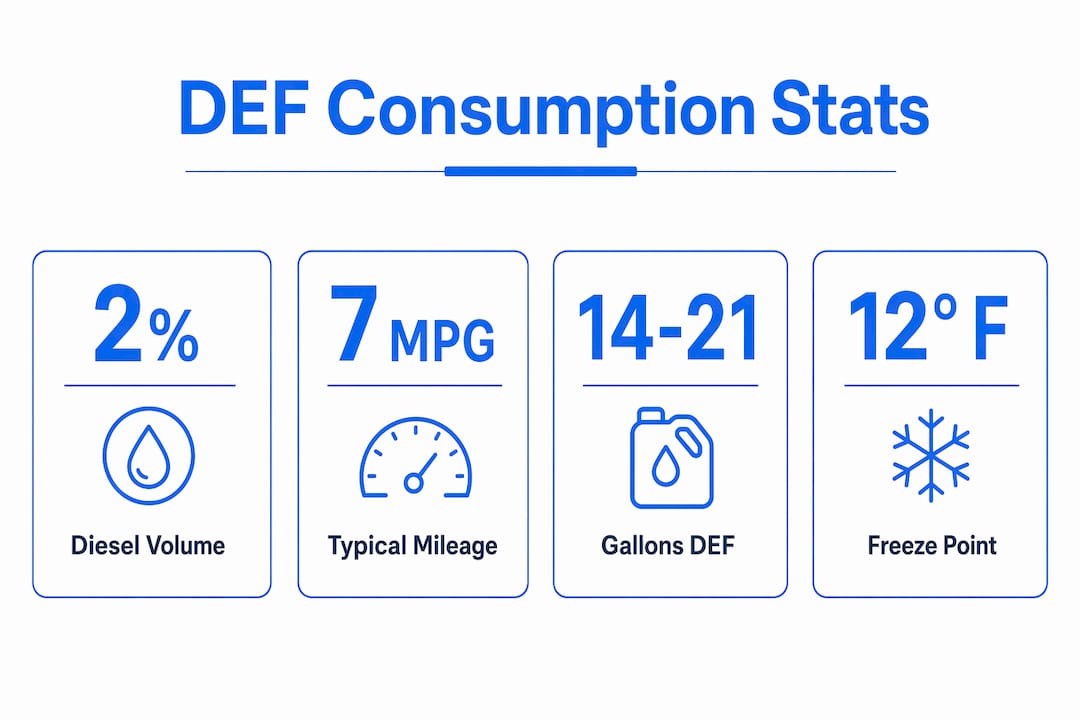
The core formula is simple: DEF gallons = diesel gallons × DEF%. To find miles per gallon of DEF: MPG ÷ DEF% (as decimal).
Here’s a worked monthly example for a single truck:
- Miles driven: 5,000
- Diesel MPG: 7
- Diesel consumed: 5,000 ÷ 7 = 714 gallons
- DEF at 2%: 714 × 0.02 = 14.3 gallons of DEF
- DEF at 3%: 714 × 0.03 = 21.4 gallons of DEF
So a single truck running 5,000 miles per month at 7 MPG needs roughly 14–21 gallons of DEF, depending on duty cycle. Scale that to a 10-truck fleet doing the same miles and you’re ordering 140–214 gallons of DEF per month.
One practical pitfall: temperature affects fluid volume. DEF expands when it freezes (freezing point is approximately 12°F), so meter readings taken in cold conditions may not reflect actual gallons dispensed. Always confirm your dispense meter is calibrated for the ambient temperature range at your site, and use FIFO rotation on packaged DEF to avoid degraded fluid sitting in storage.
What factors change how much DEF a semi truck uses?
DEF dosing is not fixed. The SCR system adjusts injection rates in real time based on how much NOx the engine is producing, and NOx output rises sharply with engine workload. Here are the primary drivers:
- Hauling weight and grade: A fully loaded 80,000-lb truck climbing grades produces significantly more NOx than the same truck running empty on flat highway. Expect DEF use to climb toward the 3% range under those conditions.
- Engine horsepower and calibration: Higher-horsepower engines running at high output burn more fuel and generate more NOx per mile, which increases DEF dosing.
- Stop-and-go vs. steady highway: Urban or regional distribution routes with frequent stops and acceleration cycles push NOx production up compared to long-haul steady-state cruising.
- Idle time: Extended idling keeps the engine running without covering miles, so your miles-per-gallon-of-DEF figure drops even if total DEF volume stays similar.
- PTO use: Power take-off operation adds engine load without adding miles, increasing DEF consumption per mile traveled.
- SCR control strategy: Different OEM calibrations dose DEF differently. Two trucks with the same engine family can show different DEF percentages depending on their emissions calibration.
Higher NOx production from harder engine work requires more DEF injection to maintain emissions compliance — the SCR system is always chasing a NOx target, not a fixed fuel ratio.
Pro Tip: Track DEF consumption per 1,000 miles rather than per fill-up. A single fill-up can be skewed by partial tanks or temperature effects. A trend line over 30 days is what tells you whether your aftertreatment system is dosing normally or whether something has changed.
Cold weather affects DEF availability (frozen fluid can’t be pumped) but does not change the dosing rate once the system is operating normally. Contamination is a separate issue: a truck that suddenly appears to be “using more DEF” may actually have a sensor fault caused by poor-quality fluid. That’s a diagnostic problem, not a consumption problem.
How do you estimate DEF needs for a trip or a fleet?
Start with the tank-range table below, then scale to your fleet.
DEF tank range by tank size and MPG (at 2% and 3% DEF use)
| Tank size | 6 MPG / 2% | 6 MPG / 3% | 8 MPG / 2% | 8 MPG / 3% | 10 MPG / 2% | 10 MPG / 3% |
|---|---|---|---|---|---|---|
| 15 gal | 4,500 mi | 3,000 mi | 6,000 mi | 4,000 mi | 7,500 mi | 5,000 mi |
| 20 gal | 6,000 mi | 4,000 mi | 8,000 mi | 5,333 mi | 10,000 mi | 6,667 mi |
| 30 gal | 9,000 mi | 6,000 mi | 12,000 mi | 8,000 mi | 15,000 mi | 10,000 mi |
Sample monthly fleet calculation for 10 trucks:
- Average miles per truck per month: 8,000
- Average diesel MPG: 7
- Diesel consumed per truck: 8,000 ÷ 7 = 1,143 gallons
- DEF per truck at 2%: 1,143 × 0.02 = 22.9 gallons
- Fleet total (10 trucks): 229 gallons of DEF per month
- At 3%: 343 gallons per month
That range is your ordering window. For a fleet this size, totes or bulk storage options often make more sense than individual jugs, improving cost efficiency and handling. You can compare the cost math in detail at the bulk DEF vs. totes guide.
Decision rules:
- Keep a buffer of at least one full DEF tank’s worth of fluid on hand per truck, or 10–20% of monthly fleet volume in reserve storage.
- For emergency coverage, either stock a case of 2.5-gallon jugs per truck or establish a same-day delivery contract before you need it.
- If any truck is running routes longer than the tank range shown above, pre-plan a DEF top-off stop or carry a spare jug.
How should you monitor DEF levels and maintain fluid quality?
The simplest monitoring system is also the most reliable: check the in-cab DEF gauge at every pre-trip inspection and top off at every diesel fill. Most modern semis display DEF level on the instrument cluster alongside fuel level. If your trucks have telematics, DEF level alerts can be configured to notify dispatch before a truck hits the warning threshold.
For fleet-level visibility, tank sensors on bulk storage combined with a telematics integration give you a real-time picture of both truck-level and site-level DEF inventory. That combination catches low-supply situations before they become emergency situations.
Quality control matters as much as quantity. Contaminated or poor-quality DEF can trigger sensor faults that look like consumption problems but are actually diagnostic failures. The maintenance checklist that prevents most issues:
- Store DEF in sealed, dedicated containers — never in tanks that previously held diesel, coolant, or other fluids
- Keep storage temperature between 12°F and 86°F; avoid prolonged exposure above 86°F, which degrades urea concentration
- Use FIFO rotation on packaged DEF; shelf life is typically 12 months from manufacture at proper temperatures
- Transfer DEF only through dedicated, clean pumps and hoses — no shared equipment with other fluids
- Specify ISO 22241-compliant DEF in every procurement contract
Pro Tip: Add a 60-second DEF check to your weekly PM checklist: verify gauge reading, inspect the fill cap seal for cracks or contamination residue, and confirm storage container lids are sealed. Catching a cracked cap costs nothing; replacing an SCR catalyst costs thousands.
What happens if a semi truck runs out of DEF or uses bad fluid?
Running low or dry triggers a sequence of increasingly serious consequences:
- Early warning: DEF level warning light on the instrument cluster, typically at 10–15% tank capacity
- Reduced power derate: Engine power is reduced to encourage the driver to refuel DEF; the exact threshold varies by OEM and model year
- Limp-home mode: Severe power restriction that limits vehicle speed, usually triggered when the tank approaches empty
- Sensor faults from contaminated DEF: Poor-quality fluid can cause SCR sensor failures, which the engine management system may treat as a DEF system fault, triggering derates even with fluid present
- Long-term SCR damage: Repeated use of non-compliant DEF or extended operation with contaminated fluid can damage the SCR catalyst and DEF injector, both expensive components
If you hit a low-DEF warning on the road, the immediate steps are:
- Add ISO 22241-compliant DEF as soon as possible — do not add water, coolant, or any other fluid to the DEF tank.
- If the warning persists after topping off, treat it as a sensor or contamination issue, not a quantity issue.
- Pull fault codes and contact your fleet tech or OEM support line before attempting a restart if the truck has entered limp-home mode.
- Follow your specific OEM’s recovery procedure — derate thresholds and reset steps vary between Cummins, Detroit, PACCAR, and other engine families.
EPA guidance issued in 2025–2026 gives manufacturers flexibility to use NOx sensors or alternative monitoring strategies in place of legacy DEF sensors, which reduces false-positive derates from sensor failures. As OEMs release software updates that implement this flexibility, operators should apply those updates promptly — they directly reduce the number of unnecessary derates your fleet experiences.
What standards and OEM guidance should you follow?
ISO 22241 is the governing standard for DEF quality, storage, handling, and contamination limits. It covers everything from urea concentration (32.5% by weight) to acceptable container materials and transfer equipment. Specifying ISO 22241 compliance in your DEF procurement contracts is the single most effective quality control step a fleet can take. The ISO 22241 procurement guide walks through the contract language and supplier verification steps in detail.
EPA requirements mandate that SCR-equipped engines monitor DEF supply and quality and trigger inducements when either falls out of spec. The EPA’s Phase 3 heavy-duty greenhouse gas rule requires engines to identify DEF consumption rates on demand (gallons per mile or gallons per gallon of diesel) and to trigger a derate when DEF supply falls to 2.5% of tank capacity or three hours of remaining operation. The 2025–2026 EPA guidance reduces mandatory speed/power inducements for sensor failures and shifts emphasis to dashboard notifications, which should decrease sudden derates from sensor issues.
OEM recommendations (Cummins and others) consistently point to three practices: top off DEF at every diesel refuel, use only ISO 22241-compliant fluid, and never attempt to delete or bypass the SCR system. Removing DEF from the equation requires reworking the entire engine system, reduces performance and durability, and creates serious regulatory liability.
Compliance checklist for procurement and handling:
- Source DEF from suppliers who can provide ISO 22241 certification documentation
- Verify labeling on every delivery: urea concentration, manufacture date, and lot number
- Store below 86°F and above 12°F in dedicated, sealed containers
- Use dedicated transfer pumps and hoses — no shared equipment
- Keep dispense records (date, volume, truck ID) for at least 12 months
Key Takeaways
Semi trucks typically use a low single-digit percentage of diesel fuel volume as DEF, translating to several hundred to around a thousand miles per gallon of DEF depending on MPG and duty cycle — top off at every diesel fill and track consumption per 1,000 miles to catch problems early.
| Point | Details |
|---|---|
| Use 2% as your planning number | For every 50 gallons of diesel burned, budget 1 gallon of DEF across most duty cycles. |
| Top off at every diesel fill | Cummins and other OEMs recommend this as the simplest way to prevent running dry. |
| Track DEF per 1,000 miles | Trend data over 30 days reveals aftertreatment or calibration issues that single fill-ups miss. |
| Specify ISO 22241 in procurement | Compliant fluid prevents sensor faults and SCR damage that cost far more than the DEF itself. |
| Defsales resources | Defsales provides DEF consumption calculators, storage guides, and fleet planning tools to put these numbers to work. |
Get your DEF supply and planning tools in one place
Running the math on DEF consumption is straightforward once you have the right inputs. Acting on it — scheduling reliable delivery before a truck runs dry — is where most fleets lose time.
Defsales connects fleet managers and owner-operators with practical tools and trusted supply options. Use the DEF consumption calculator to plug in your actual MPG and monthly miles and get a precise ordering volume in under a minute. When you’re ready to set up recurring bulk delivery or need same-day supply, Anytime Fuel Pros handles DEF delivery in San Antonio, Austin, Dallas, and Salt Lake City, with nationwide coverage through their partner network. For a full breakdown of delivery formats and service models, the DEF delivery services guide covers bulk tanks, totes, and wet-hosing options side by side.
This article is general operational guidance. Confirm current DEF specifications, derate thresholds, and recovery procedures with your OEM’s documentation or a qualified diesel technician for your specific engine family.