

Diesel exhaust fluid usage is defined as the volume of DEF consumed relative to diesel fuel burned in any engine equipped with a Selective Catalytic Reduction (SCR) system. The standard planning figure for DEF consumption per diesel gallon is 2–3% of diesel use, meaning a truck burning 100 gallons of diesel will consume roughly 2–3 gallons of DEF. That ratio is not fixed. Engine manufacturer, duty cycle, load, and temperature all push it higher or lower. Fleet managers who treat 2–3% as a hard number rather than a baseline will consistently run short or overstock, both of which cost money.
What factors influence DEF consumption rates in diesel fleets?
DEF dosing is controlled by the engine’s control module, not by fuel combustion. DEF consumption tracks exhaust volume, specifically the amount of NOx the SCR catalyst needs to neutralize. A lightly loaded highway truck produces less exhaust than a fully loaded one climbing grades, so its DEF rate stays lower. That distinction matters when you are planning supply across a mixed fleet.
The main variables that shift DEF usage per gallon of diesel include:
- Engine manufacturer and calibration. Cummins, Detroit Diesel, and PACCAR each program their Engine Control Modules differently. Dosing strategies vary even within the same horsepower class.
- Duty cycle and load. Heavy construction or mining vehicles should budget for DEF consumption well above the standard 2–3% baseline. Continuous high-load operation pushes rates to 5% or higher.
- Terrain and driving conditions. Stop-and-go urban routes generate more exhaust events than steady highway miles, which increases SCR activity and DEF draw.
- Ambient temperature. Cold weather affects DEF viscosity and SCR catalyst efficiency. Some systems compensate by adjusting dosing frequency, which changes consumption patterns.
- SCR system calibration and sensor health. A miscalibrated dosing injector or a failing NOx sensor can cause the system to over-dose or under-dose, distorting your actual consumption ratio.
The 2–3% figure is a conservative baseline, not a ceiling. Vocational fleets running excavators, haul trucks, or concrete mixers routinely see rates closer to 5%. Plan your DEF inventory around your actual duty cycle, not the industry average.
Pro Tip: Record DEF fill volumes alongside diesel fill volumes for every vehicle in your fleet for at least 30 days. That data will reveal your real fleet-wide consumption ratio and expose any outliers with dosing problems.

How to calculate and monitor your fleet’s DEF consumption per diesel gallon
Calculating your DEF usage per gallon of diesel is straightforward once you collect the right data. The formula is:
DEF Consumption Ratio (%) = (DEF Used ÷ Diesel Used) × 100
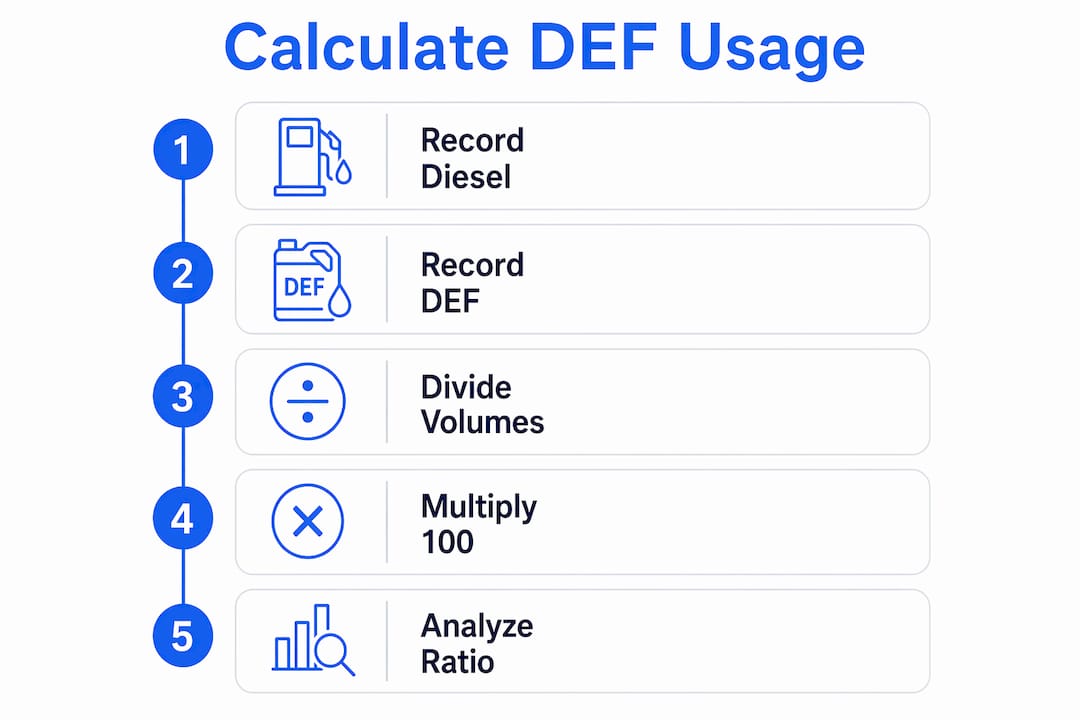
A truck that consumed 9 gallons of DEF over the same period it burned 300 gallons of diesel has a 3% consumption ratio. That sits within the normal range. A ratio above 5% on a highway truck warrants an SCR system inspection.
Follow these steps to build a reliable consumption tracking process:
- Record every DEF fill. Log the date, vehicle ID, gallons added, and DEF tank level before filling. Inconsistent logging is the most common reason fleet managers cannot spot dosing anomalies.
- Record every diesel fill at the same time. Pair DEF and diesel data by vehicle and time period. Weekly or bi-weekly intervals work well for most fleets.
- Calculate the ratio per vehicle. Run the formula above for each unit. Aggregate fleet-wide data separately from individual vehicle data.
- Set threshold alerts. Flag any vehicle with a ratio above 5% or below 1.5%. Both extremes indicate a potential SCR system problem.
- Review trends monthly. A single high reading may be noise. A consistent upward trend over four weeks signals a real issue.
The DEF calculator at Defsales lets you input diesel consumption figures and get an estimated DEF requirement instantly, which is useful for procurement planning before you have historical data.
| Data Input | Why It Matters |
|---|---|
| Diesel consumed (gallons) | Base figure for calculating the DEF ratio |
| DEF added (gallons) | Actual consumption to compare against the baseline |
| Vehicle ID | Isolates outliers from fleet averages |
| Operating period (days) | Normalizes data across different reporting windows |
| Duty cycle classification | Adjusts expected ratio for light, medium, or heavy use |
Telematics systems provide real-time DEF tank level data and can flag consumption anomalies automatically. Platforms that integrate with your fleet management software eliminate manual logging entirely and catch dosing problems before they cause downtime.
Pro Tip: If a vehicle’s DEF ratio suddenly drops below 1%, check the dosing injector and NOx sensor before assuming the engine is running cleaner. Under-dosing is an emissions violation risk, not a cost savings.
Bulk vs. retail DEF: which option fits your fleet’s cost structure?
DEF procurement strategy directly affects your per-gallon operating cost. Retail DEF at truck stops runs $3–$5 per gallon. Bulk DEF delivered to your site costs as little as $0.80 per gallon in 2026. That gap is significant at fleet scale.
| Supply Format | Typical Price per Gallon | Best For | Key Drawback |
|---|---|---|---|
| Retail 2.5-gallon jugs | $4.00–$6.00 | Single vehicles, emergency backup | Highest per-gallon cost |
| Truck stop dispensers | $3.00–$5.00 | Over-the-road drivers | Inconvenient for on-site fleets |
| Totes (275–330 gallon) | $1.50–$2.50 | Small to mid-size fleets | Requires forklift or pump |
| Bulk delivery (500+ gallons) | $0.75–$1.50 | Large fleets with on-site storage | Requires storage tank investment |
For a fleet burning 5,000 gallons of diesel per month at a 3% DEF rate, that is 150 gallons of DEF monthly. At retail prices, that costs $600–$900. At bulk pricing, the same volume costs $112–$225. The full cost comparison between bulk DEF and jugs shows the break-even point for bulk storage investment typically arrives within a few months for fleets above 10 vehicles.
Key considerations when choosing your supply format:
- Storage infrastructure. Bulk tanks require a capital investment and proper secondary containment. DEF must be stored between 12°F and 95°F to preserve quality.
- Shelf life. DEF stored correctly lasts approximately one year. Overstocking bulk DEF in warm climates accelerates degradation.
- Delivery scheduling. Bulk delivery from Anytime Fuel Pros, which serves fleets in San Antonio, Austin, Dallas, and Salt Lake City, eliminates the labor cost of managing retail purchases across multiple drivers.
Pro Tip: Never store DEF in galvanized steel containers. Zinc reacts with the urea solution and contaminates the fluid, which will damage your SCR system and void warranties.
Common DEF tank management mistakes and how to avoid downtime
Running out of DEF is not a minor inconvenience. An empty DEF tank triggers an enforced engine shutdown, and the vehicle cannot restart until a minimum quantity of DEF is added. That minimum refill requirement exists because the SCR system must confirm adequate fluid before allowing engine operation. A truck stranded on a job site or at a loading dock costs far more than a bulk DEF delivery.
Compliance note: EPA NOx emission regulations carry penalties of up to $45,268 per violation. Operating a diesel vehicle with a disabled or bypassed SCR system is not a gray area. DEF supply management is a regulatory obligation, not just an operational preference.
The most common DEF tank management failures include:
- Ignoring low-level warnings. Most SCR systems issue alerts at 10% tank capacity. Drivers who dismiss the first warning and wait for the second are one short trip away from a shutdown.
- Skipping DEF checks during pre-trip inspections. DEF tank level should be part of every daily vehicle inspection, the same as engine oil and coolant.
- Contaminating DEF during refill. Diesel fuel, water, or other fluids introduced into the DEF tank will damage the SCR catalyst. Use dedicated DEF dispensing equipment and follow proper handling procedures every time.
- No emergency supply on site. Fleets without a backup DEF supply face extended downtime waiting for delivery. Keep at least one tote or a set of 2.5-gallon jugs on site as a buffer.
Strong DEF supply management is a risk mitigation strategy, not just a logistics task. Fleets that treat DEF the same way they treat diesel fuel, with scheduled deliveries, monitored tank levels, and documented fill records, avoid the shutdowns and fines that catch underprepared operators.
Pro Tip: Set your DEF reorder point at 25% tank capacity, not 10%. That buffer gives you time to schedule a delivery without risking a shutdown, especially on weekends or during peak demand periods.
Defsales resources for fleet DEF consumption planning
Defsales provides fleet managers with the tools and information needed to move from guesswork to data-driven DEF management.
The DEF consumption calculator at Defsales lets you enter your diesel usage figures and get an accurate DEF volume estimate in seconds. That number feeds directly into your procurement planning and helps you right-size bulk orders before you have months of historical data. The fleet guides section covers bulk delivery scheduling, storage setup, and compliance questions in detail. When you are ready to move from retail jugs to on-site bulk supply, Anytime Fuel Pros handles bulk DEF delivery for fleets across San Antonio, Austin, Dallas, and Salt Lake City, with nationwide coverage through its partner network.
Key takeaways
DEF consumption per diesel gallon runs 2–3% under standard conditions, but heavy-duty and vocational fleets must plan for rates up to 5% or higher based on actual duty cycle data.
| Point | Details |
|---|---|
| Standard consumption ratio | Budget 2–3% of diesel volume for DEF under normal operating conditions. |
| Heavy-duty adjustment | Construction, mining, and vocational fleets should plan for up to 5% DEF consumption. |
| Calculation method | Divide DEF used by diesel used, then multiply by 100 to get your consumption percentage. |
| Bulk pricing advantage | Bulk DEF costs as little as $0.80 per gallon versus $4.00–$6.00 at retail. |
| Shutdown risk | An empty DEF tank triggers an enforced engine shutdown requiring a minimum refill before restart. |
FAQ
What is the standard DEF consumption per diesel gallon?
DEF consumption runs approximately 2–3% of diesel fuel volume under normal operating conditions. A truck burning 150 gallons of diesel per day will use roughly 3–4.5 gallons of DEF.
Why does my DEF usage per gallon seem higher than 3%?
Heavy load, steep terrain, stop-and-go driving, and high exhaust temperatures all increase SCR activity. Vocational equipment in construction or mining regularly sees DEF rates of 5% or more.
Can a faulty sensor cause abnormal DEF efficiency in diesel systems?
A failing NOx sensor or dosing injector can cause the SCR system to over-dose or under-dose DEF. Either condition shows up as an abnormal consumption ratio and requires immediate inspection.
What happens if I run out of DEF on the road?
The engine will derate and eventually shut down. A minimum quantity of DEF must be added before the engine will restart, making roadside DEF shortages a serious operational problem.
Is bulk DEF delivery worth it for smaller fleets?
Fleets running as few as five to ten diesel vehicles typically save enough on per-gallon cost to offset bulk storage setup within a few months. The break-even analysis depends on your monthly diesel consumption and current retail DEF spend.