
Comprehensive FAQ
Your DEF questions answered
The most comprehensive resource for Diesel Exhaust Fluid questions on the web. From basic DEF chemistry to fleet management, EPA compliance, storage best practices, and finding bulk DEF delivery near you — find clear, accurate answers to every DEF question below.
DEF Basics
8 questions
What is Diesel Exhaust Fluid (DEF)?
DEF is a non-toxic aqueous urea solution made of 32.5% high-purity urea and 67.5% deionized water. It is injected into the exhaust stream of diesel engines equipped with Selective Catalytic Reduction (SCR) technology, where it converts harmful nitrogen oxide (NOx) emissions into harmless nitrogen gas and water vapor. DEF is required by all diesel engines meeting EPA Tier 4 and EPA 2010 emissions standards.
Is DEF the same as AdBlue?
Yes — DEF and AdBlue are the same fluid with different regional names. DEF is the term used in North America. AdBlue is a trademarked name used in Europe and Australia. Both meet ISO 22241 specifications and are chemically identical — 32.5% urea in deionized water. They are fully interchangeable.
Is DEF toxic or dangerous to handle?
No. DEF is non-toxic, non-flammable, and non-hazardous. It is safe to handle without special protective equipment, though gloves are recommended as DEF can be mildly irritating to skin with prolonged exposure. If spilled, DEF should be rinsed with water. It is not classified as a dangerous good for transport purposes.
What does DEF smell like?
Fresh, properly stored DEF has a faint ammonia-like odor. If DEF has a strong or pungent ammonia smell, it may have degraded due to heat exposure or contamination. Degraded DEF should be tested with a urea concentration refractometer before use — it should read 32.5% ± 0.7%.
What is DEF made of?
DEF is made of two ingredients: 32.5% high-purity synthetic urea and 67.5% deionized water. The urea used in DEF is synthetically produced to pharmaceutical-grade purity — it is not the same as agricultural urea, which contains contaminants that would damage SCR systems. The water is deionized to remove all minerals and impurities.
Why is the urea concentration exactly 32.5%?
32.5% is the eutectic point of the urea-water solution — meaning this specific concentration has the lowest possible freezing point of any urea-water mixture, at 12°F (-11°C). A higher or lower concentration would freeze at a higher temperature, making cold-weather operation more problematic. ISO 22241 allows a tolerance of ±0.7%, so DEF must contain between 31.8% and 33.2% urea.
Can I add water to DEF to stretch supply?
No — never dilute DEF. Adding water reduces the urea concentration below ISO 22241 specifications, making the DEF ineffective at reducing NOx emissions. The SCR system will detect off-spec DEF through NOx sensors and may trigger fault codes, limp mode, or warranty-voiding damage. If you are running low, contact a bulk DEF delivery service near you for emergency on-site delivery.
Is DEF a fuel additive?
No. DEF is never added to diesel fuel. It is stored in a completely separate tank on the vehicle or equipment and injected directly into the exhaust stream — never into the fuel system. DEF fill ports are intentionally designed to be smaller than diesel nozzles to prevent accidental misfueling.
SCR Systems
6 questions
What is Selective Catalytic Reduction (SCR)?
Selective Catalytic Reduction (SCR) is an emissions control technology that uses DEF to convert nitrogen oxides (NOx) into harmless nitrogen gas (N₂) and water vapor (H₂O). DEF is injected into the exhaust stream, decomposes into ammonia, and reacts with NOx in the SCR catalyst. The process reduces NOx emissions by up to 90%, enabling compliance with EPA Tier 4 and Euro 6 standards.
What happens when my diesel engine runs out of DEF?
Modern diesel engines have EPA-mandated fail-safes that activate progressively as DEF levels drop: ~10% remaining — dashboard warning light activates. ~5% remaining — alerts escalate. ~2.5% remaining — engine enters limp mode, power reduced to 25–40%. Empty + engine off — engine will not restart until DEF is added. Contact Anytime Fuel Pros for emergency DEF delivery near you.
Can I delete or bypass my SCR system?
No — this is a federal crime. SCR delete devices are illegal under the Clean Air Act. The EPA actively pursues enforcement against individuals, fleets, and shops that install or sell defeat devices. Penalties include fines of up to $44,539 per day per violation plus potential criminal prosecution and equipment seizure.
How does the DEF dosing system work?
The dosing control unit (DCU) calculates the precise DEF injection rate in real time based on NOx sensor readings upstream of the catalyst, exhaust temperature, engine load data from the ECU, and the target NOx reduction efficiency. The dosing injector sprays a fine mist of DEF into the hot exhaust stream, where it evaporates and decomposes into ammonia before reaching the SCR catalyst.
What causes SCR system fault codes?
Common causes of SCR fault codes include: low or empty DEF tank, off-spec or contaminated DEF (urea concentration outside ISO 22241 tolerance), failed NOx sensors (upstream or downstream of catalyst), clogged or failed DEF injector, degraded SCR catalyst (from contaminated DEF or normal wear), and DEF quality sensor faults. Never clear and ignore SCR codes without diagnosis.
Do all diesel engines require DEF?
No. DEF is required by diesel engines that use SCR technology to meet EPA Tier 4 Final (non-road) or EPA 2010 (on-road) emissions standards. Older engines built to Tier 3 or earlier standards typically used different emissions control strategies and do not require DEF. Check your engine's emissions certification plate to confirm which standard applies.
Storage & Handling
7 questions
What temperature should DEF be stored at?
DEF should be stored between 12°F and 86°F (-11°C to 30°C). The ideal range for maximum shelf life is below 77°F (25°C). Above 86°F, urea begins to break down into ammonia, reducing concentration below ISO 22241 minimums. DEF containers should be kept out of direct sunlight and away from heat sources.
Can DEF freeze? Does freezing damage it?
DEF freezes at 12°F (-11°C). However, freezing does not damage DEF — once thawed naturally at room temperature, it returns to its original composition and ISO 22241 specification. Do not apply direct heat or add hot water to thaw. Most modern SCR-equipped vehicles have DEF tank heaters to manage cold-weather operation automatically.
How long does DEF last in storage?
When stored correctly (below 77°F, away from sunlight), DEF has a shelf life of approximately 1–2 years. Every 10°C increase above the ideal storage temperature approximately halves the remaining shelf life. Most DEF containers are date-stamped at manufacture. Practice FIFO (first in, first out) rotation in bulk storage tanks.
Can DEF be stored in a metal container?
Only in stainless steel (grade 304 or 316). DEF reacts with copper, zinc, aluminum, and carbon steel, causing corrosion and contamination that can damage SCR catalysts. Purpose-built DEF storage tanks are made from high-density polyethylene (HDPE) or stainless steel. Never use repurposed containers from other fluids.
What contaminates DEF?
The most common DEF contaminants are: diesel fuel (even trace amounts can damage the SCR catalyst), copper and zinc from incompatible containers or fittings, tap water or non-deionized water (introduces minerals that alter urea concentration), and residue from repurposed containers. Always use DEF-dedicated equipment exclusively.
How do I know if my DEF has gone bad?
Degraded DEF may show a stronger-than-normal ammonia smell or appear slightly yellow or cloudy. However, DEF can be out of specification without any visible signs. If you suspect degradation — especially after extended heat exposure — use a urea concentration refractometer to test. DEF must read 32.5% ± 0.7% to be ISO 22241 compliant.
Can I mix different brands of DEF?
Yes, as long as both products meet ISO 22241 specifications. DEF is a standardized product — any ISO-compliant DEF from any certified supplier is chemically identical and can be mixed without issue. Always verify your supplier certifies their product meets ISO 22241 and request documentation if needed.
EPA & SCR Compliance
5 questions
Is it illegal to operate a diesel engine without DEF?
Yes. Operating a Tier 4 or EPA 2010-compliant diesel engine without DEF violates the federal Clean Air Act. While the engine's built-in fail-safes will eventually prevent operation, attempting to operate without DEF or tampering with the system to bypass the fail-safe is a federal violation subject to civil penalties of up to $44,539 per day per violation.
What is EPA Tier 4 and who does it apply to?
EPA Tier 4 is the emissions standard for non-road diesel engines — construction equipment, agricultural machinery, generators, and industrial equipment. Tier 4 Final, fully phased in by 2015, requires SCR technology and DEF use in all non-road engines above 25 horsepower. On-road trucks are covered under the equivalent EPA 2010 heavy-duty highway rule.
Will running without DEF void my engine warranty?
Yes. Running an SCR-equipped engine without DEF, or with off-spec DEF, voids the manufacturer warranty on the SCR system and potentially the entire engine. SCR catalyst replacement alone can cost $5,000–$15,000 or more depending on equipment size. Using ISO 22241-certified DEF from a reputable bulk DEF delivery service protects both compliance and your warranty.
What happens during a DEF compliance inspection?
Commercial vehicles are subject to roadside DEF system inspections by DOT and state enforcement officers. Inspectors may check DEF tank level, verify the SCR system is operational, check for active fault codes, and in some cases test DEF quality. A failed inspection can result in an out-of-service order, pulling the vehicle from revenue service until the issue is resolved.
What documentation should I keep for DEF compliance?
Best practice is to maintain records of all DEF purchases and deliveries including: supplier name and contact, delivery date and quantity, ISO 22241 certification documentation, and invoice records. In an EPA audit or warranty claim situation, documented proof that you sourced compliant DEF from a certified supplier demonstrates good-faith compliance.
Fleet Management
5 questions
How much DEF does my fleet consume?
DEF consumption runs at approximately 2–5% of diesel fuel usage depending on engine load, equipment type, and duty cycle. For a fleet consuming 10,000 gallons of diesel per month, expect to use 200–500 gallons of DEF. Use the DEF consumption calculator for a precise estimate based on your fleet's specific usage profile.
What size bulk DEF tank does my fleet need?
A good rule of thumb is a tank that holds 1.5–2x your monthly DEF consumption. For a fleet using 300 gallons per month, a 500–600 gallon tank allows monthly delivery with a comfortable buffer. For larger fleets consuming 1,000+ gallons monthly, 2,500–5,000 gallon tanks are common for weekly or bi-weekly scheduled bulk DEF delivery.
How often should I schedule DEF delivery?
Schedule DEF delivery when your tank reaches 25–30% capacity — never let it drop to the point where a delivery miss could cause a compliance issue. For most mid-size fleets, bi-weekly or monthly bulk deliveries are typical. Anytime Fuel Pros can help establish the right delivery cadence based on your consumption rate and storage capacity.
Why did my DEF consumption suddenly increase?
A sudden increase in DEF consumption is often an early indicator of an SCR system issue. Common causes include: degraded SCR catalyst (requiring more DEF for same NOx reduction), failed NOx sensor (causing over-dosing), DEF injector malfunction, or off-spec DEF causing the system to compensate. Have the vehicle diagnosed with an OBD scan tool as soon as possible.
Should I keep emergency DEF jugs in each vehicle?
Yes — even with scheduled bulk DEF delivery near you, keeping a 2.5-gallon emergency jug in each vehicle is good fleet management practice. The cost is minimal ($20–25) compared to the cost of a limp mode event on the road — towing, lost productivity, and emergency sourcing can easily run $500–2,000 per incident.
DEF Delivery
5 questions
Where can I get bulk DEF delivered near me?
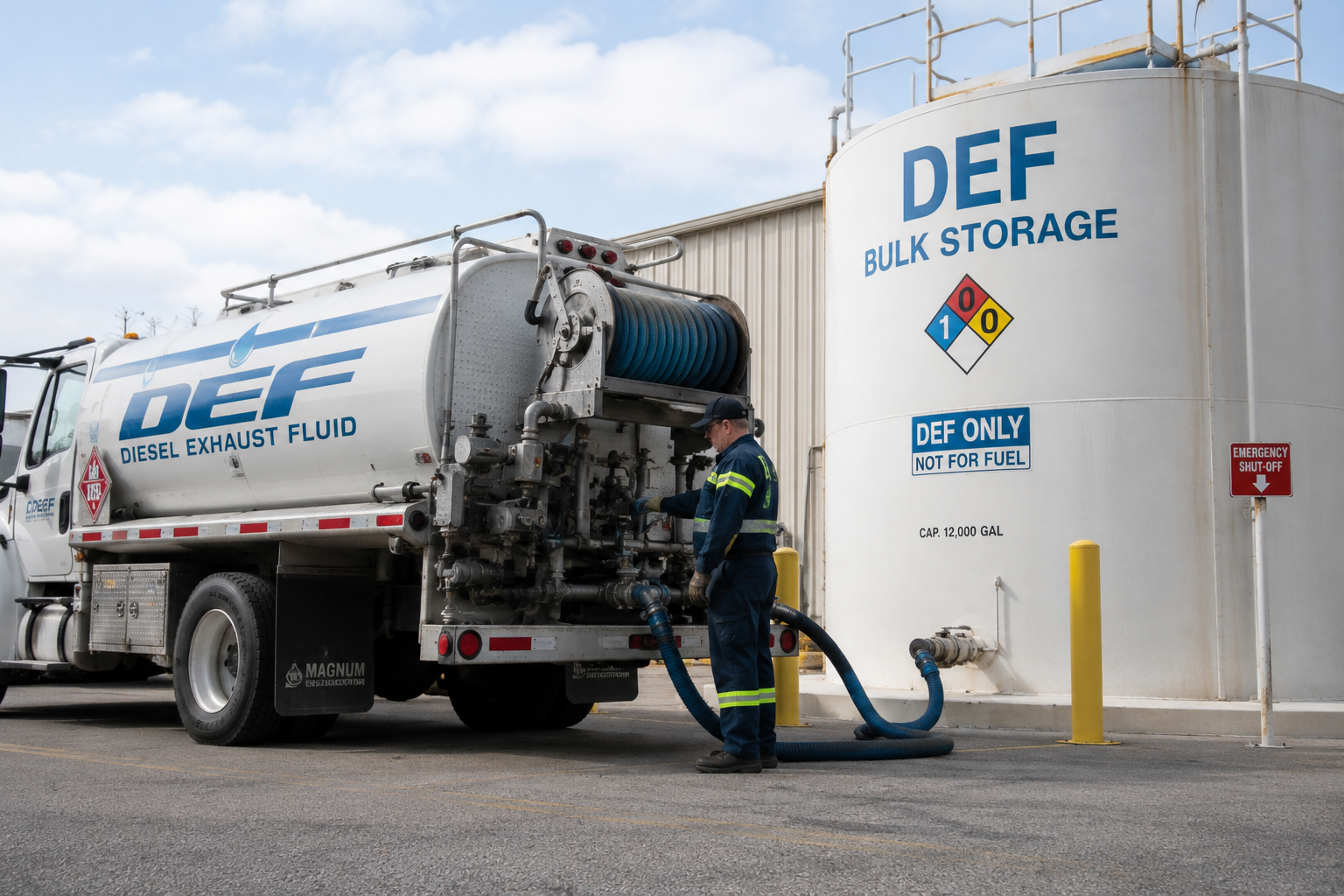
Anytime Fuel Pros provides nationwide bulk DEF delivery service directly to fleet yards, construction sites, and job locations. If you've been searching for DEF delivery near me, Anytime Fuel Pros offers on-site diesel exhaust fluid delivery with same-day and next-day service available in most markets. No contracts required — contact them for a custom bulk DEF delivery quote.
Can I get same-day emergency DEF delivery?
Yes. Anytime Fuel Pros offers same-day and next-day emergency on-site DEF delivery in most markets nationwide. If your fleet or equipment is approaching limp mode or you're unexpectedly low on DEF, contact Anytime Fuel Pros immediately for emergency bulk diesel exhaust fluid delivery to your location.
Is bulk DEF delivery more cost-effective than buying jugs?
Significantly. Retail DEF jugs typically cost $8–10 per gallon. Scheduled bulk DEF delivery typically costs $1–2 per gallon — a savings of 60–80%. For a fleet consuming 300 gallons per month, that translates to approximately $25,000–35,000 in annual savings compared to purchasing retail jugs.
What is the minimum order for bulk DEF delivery?
Minimum order quantities vary by supplier and market. Contact Anytime Fuel Pros directly to discuss minimum delivery quantities and scheduling options for your specific location and consumption volume. They serve operations of all sizes — from small construction sites to large commercial fleets.
Does the DEF delivered meet ISO 22241 standards?
Yes. Anytime Fuel Pros delivers bulk DEF that meets ISO 22241 purity specifications on every load. Always request ISO 22241 certification documentation from any commercial DEF delivery service — this is essential for warranty protection and EPA compliance documentation. Never accept bulk DEF from a supplier who cannot provide certification.
Quality & Standards
4 questions
What is ISO 22241?
ISO 22241 is the international standard governing DEF quality, composition, testing, handling, transportation, and refilling. It consists of four parts: ISO 22241-1 (chemical requirements), ISO 22241-2 (test methods), ISO 22241-3 (handling, transportation, storage), and ISO 22241-4 (refilling interface). DEF must meet ISO 22241 to be legally used in SCR-equipped diesel engines.
What happens if I use off-spec DEF?
Using DEF outside ISO 22241 specifications can cause: SCR catalyst damage or failure ($5,000–15,000+ to replace), DEF injector clogging, NOx sensor fouling, engine fault codes and limp mode, warranty voidance, and EPA compliance violations. Always source DEF from ISO 22241-certified suppliers like Anytime Fuel Pros.
How can I test DEF quality on site?
The most practical on-site DEF quality test uses a urea concentration refractometer — an inexpensive optical instrument that reads urea concentration from a few drops of DEF. ISO 22241-compliant DEF should read 32.5% ± 0.7% (between 31.8% and 33.2%). Dedicated DEF refractometers are available for $20–50 and should be part of any fleet manager's toolkit.
Is agricultural urea the same as DEF urea?
No — never use agricultural urea to make homemade DEF. Agricultural urea (used as fertilizer) contains contaminants including biuret, aldehydes, and trace metals that do not meet ISO 22241 specifications and will damage SCR catalysts. DEF urea is synthetically produced to pharmaceutical-grade purity under controlled conditions. Homemade DEF is not a compliant or safe substitute.
Still have questions? Need DEF delivered?
Get a delivery quote
Nationwide bulk DEF delivery from Anytime Fuel Pros
If you've been searching for DEF delivery near me or need a reliable bulk diesel exhaust fluid supplier for your fleet or construction operation, Anytime Fuel Pros delivers ISO 22241-certified DEF nationwide — direct to your yard or job site. Same-day and next-day on-site DEF delivery service available in most markets. No contracts required.