

Most diesel engines dose DEF at 2 to 3% of diesel burned, with light-duty pickups running closer to 1 to 2% and off-road equipment sometimes hitting 3 to 5%. The quick math: 2% dosing works out to roughly 1 gallon of DEF per 50 gallons of diesel, and for a Class 8 truck averaging 6 to 7 MPG, that’s about 300 to 350 miles per gallon of DEF. Your ECU controls the actual rate in real time, so treat these numbers as planning estimates, not guarantees.
TL;DR:
- Light-duty pickups typically consume 1 to 2% DEF of diesel burned, translating to approximately one gallon of DEF every 1,200 miles at 18 MPG.
- DEF dosing rates vary depending on load, engine demands, and temperature, often exceeding initial estimates during heavy use or regeneration.
- Tracking DEF consumption through purchase volumes and fault codes helps maintain dosing accuracy and prevent deposit buildup.
- Using fleet-specific calculations and scheduled delivery options ensures supply reliability and cost control for larger operations.
Table of Contents
- Typical DEF Dosing Rate Ranges by Application
- How to Calculate DEF Consumption for Your Fleet
- Why Actual Dosing Rates Vary From the Estimate
- Real-World DEF Planning Numbers by Vehicle Class
- Monitoring and Maintaining Your DEF Dosing System
- Where to Find DEF Calculators and Standards Guidance
- Get Your DEF Numbers Dialed In and Schedule Delivery
- Sources
- FAQ
Typical DEF Dosing Rate Ranges by Application
The 2% “1 in 50” rule works fine for budgeting, but real dosing rates shift depending on what you’re driving and how you’re driving it. Calculator Academy’s breakdown puts typical ranges at:
- Light-duty pickups (F250/F350, Ram 2500/3500 class): 1 to 2% of diesel consumed
- On-highway Class 8 semi trucks: 2 to 3%, with most fleets landing near the middle
- Off-road and heavy equipment (excavators, generators, mining trucks): 3 to 5%, driven by different NOx output and duty cycles
Converting percent to gallons is simple arithmetic. A 2% rate means 2 to 3 gallons of DEF for every 100 gallons of diesel burned. At 6 MPG, that same 2% rate gives you roughly one DEF gallon every 300 miles. The “1 in 50” shortcut is deliberately a little conservative. It overestimates DEF use slightly for most on-highway trucks, which isn’t a bad thing when you’re stocking up and want a buffer instead of an emergency order.
How to Calculate DEF Consumption for Your Fleet
The formula fleet managers actually use is straightforward:
DEF gallons = diesel gallons × dose rate (%)
Or, if you’re thinking in miles: DEF gallons per mile = (1 ÷ MPG) × dose rate
Here’s how that plays out with two common vehicle types.
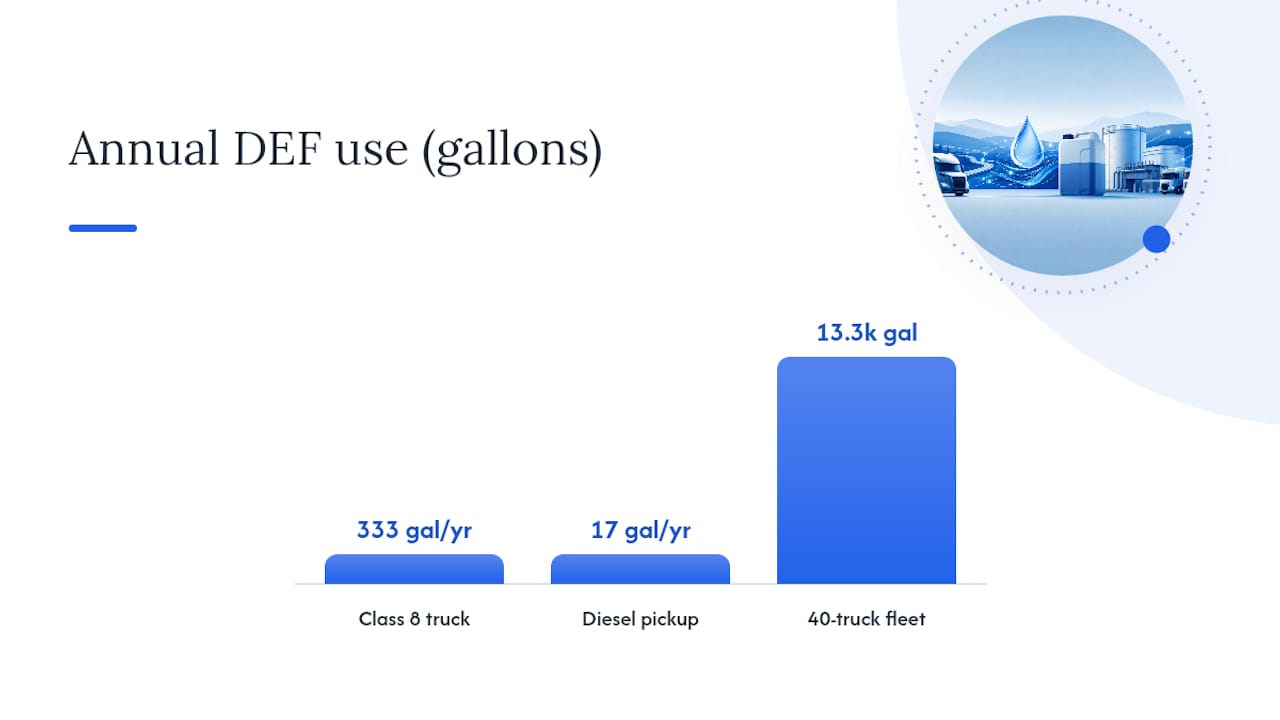
- Class 8 truck, 6 MPG, 2% dose rate. Running 100,000 miles a year burns about 16,667 gallons of diesel. At 2%, that’s 333 gallons of DEF annually, or one DEF gallon roughly every 300 miles.
- Diesel pickup, 18 MPG, 1.5% dose rate. Driving 20,000 miles a year uses about 1,111 gallons of diesel. At 1.5%, that comes to about 17 gallons of DEF a year, or one gallon covering close to 1,200 miles.
Scaling to a fleet is just multiplication. Take your average annual DEF use per vehicle, multiply by the number of trucks in that class, and you’ve got a planning number for the year. A 40-truck Class 8 fleet running the numbers above would need around 13,320 gallons of DEF annually.
Cost math follows the same pattern: multiply your DEF price per gallon by total gallons needed. DEF spend runs small per mile compared with diesel, but it still adds up to real dollars across a fleet, and it’s a line item worth tracking separately rather than lumping into general fuel costs. Fleet-specific cost breakdowns and worked totals are covered in more depth in this fleet examples and costs guide.
Why Actual Dosing Rates Vary From the Estimate
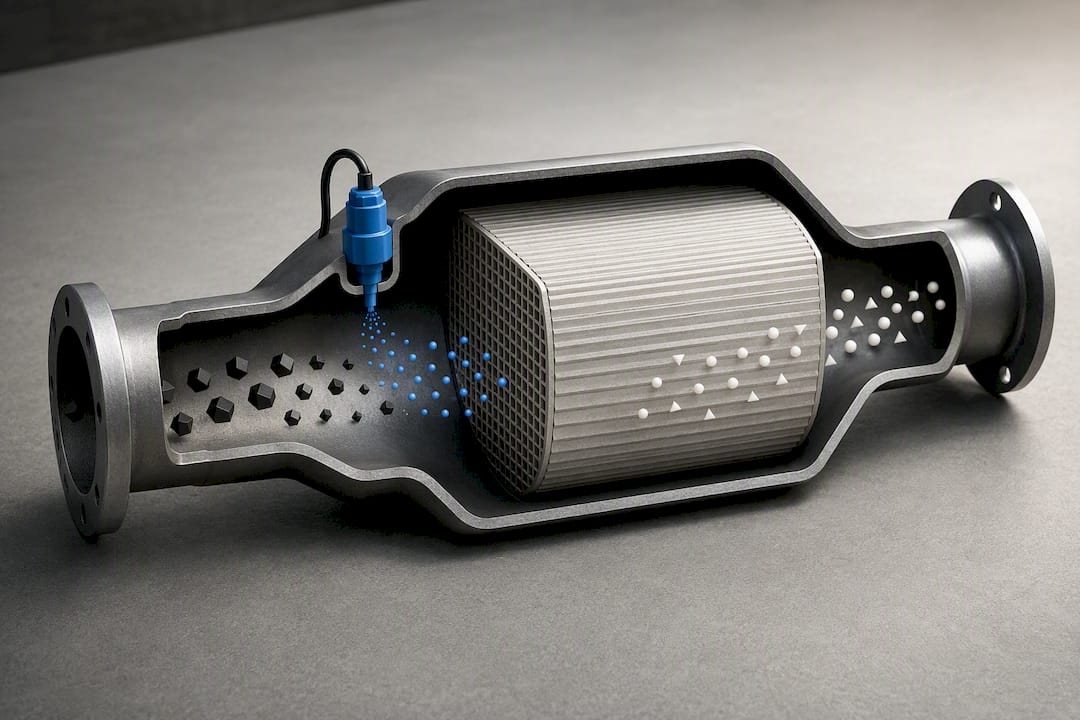
Your ECU doesn’t dose DEF off a fixed percentage. It calculates the injection rate in real time based on engine-out NOx and exhaust mass flow, using a stoichiometric relationship where roughly 1 gram of NOx requires about 1.2 grams of DEF to neutralize. That relationship is why two trucks with identical MPG can burn noticeably different amounts of DEF.
Several factors push the actual rate away from the textbook average:
- Sustained heavy loads and highway grades increase engine-out NOx, which raises dosing
- Some SCR strategies intentionally over-dose during low-load periods to “fill” the catalyst’s ammonia storage, trading a short-term consumption bump for fewer dosing events later
- Active regeneration events temporarily change exhaust temperature and flow, shifting dosing demand
- Cold weather and low exhaust temperatures raise deposit risk, since urea doesn’t decompose as cleanly at lower temperatures
Pro Tip: If your fleet operates a lot of stop-and-go or low-load hours, don’t assume low mileage means low DEF use. Idle-heavy duty cycles can burn through DEF faster than the mileage numbers suggest, because the ECU is still managing NOx and ammonia storage even when the truck isn’t covering ground.
Understanding the SCR side of this equation helps explain the DEF side. A closer look at how SCR systems manage NOx fills in the mechanical context behind these dosing decisions.
Real-World DEF Planning Numbers by Vehicle Class
Annual estimates make budgeting concrete. Here’s what typical use looks like once you plug in realistic mileage:
- Pickup (20,000 miles/year, 18 MPG, 1.5%): around 17 to 20 gallons of DEF annually, with a 5 to 8 gallon onboard tank needing a refill every few months
- Vocational truck (60,000 miles/year, 8 MPG, 2.5%): roughly 188 gallons a year, often carried in a 15 to 20 gallon tank refilled monthly or so
- Class 8 long-haul (100,000 to 120,000 miles/year, 6 MPG, 2%): 400 to 800 gallons annually depending on mileage and route, typically running a 20 to 50 gallon onboard tank
Off-road and stationary engines don’t fit this mileage model at all. Generators, excavators, and mining equipment are measured in engine hours, not miles, so dose rate ties to load and runtime instead. A generator running heavy load for 10 hours a day burns DEF on a completely different curve than a truck logging highway miles, even at a similar 3 to 5% dose rate.
Monitoring and Maintaining Your DEF Dosing System
Dosing accuracy drifts over time, and the fix is mostly about tracking, not guesswork. A short maintenance and monitoring checklist:
- Compare DEF purchase volumes against fuel receipts monthly to catch usage ratios that don’t match your assumptions
- Watch for dosing unit fault codes, which often show up before a driver notices anything wrong
- Replace dosing filters on the OEM schedule, commonly around 200,000 miles as a reference point
- Inspect injector tips periodically for crystallization or buildup
Higher dosing rates aren’t free of tradeoffs. Experimental testing on heavy-duty dosing strategies found that higher rates increase droplet size and reduce atomization quality, which raises deposit risk, particularly at lower exhaust temperatures. Keeping DEF at ISO 22241 quality, controlling storage temperature, and scheduling bulk deliveries instead of running tanks dry all reduce that risk in practice.
Where to Find DEF Calculators and Standards Guidance
Defsales built its dosing and consumption tools specifically because most of the DEF math online is either oversimplified or buried in engineering papers nobody has time to read on a shop floor. The site’s DEF calculator lets you plug in your own mileage, MPG, and dose rate instead of relying on averages.
For the standards side, Defsales covers ISO 22241 and the 32.5% urea concentration requirement in plain language, along with storage and handling practices that keep DEF from degrading before it ever reaches your SCR system. Justin, who covers the technical content on Defsales, focuses on numbers operators can actually use in daily decisions rather than theory that stays on paper. That practical bent runs through the fleet cost guides and tank-sizing breakdowns across the site.
Get Your DEF Numbers Dialed In and Schedule Delivery
Once you’ve run the math on your dose rate and annual DEF need, the next decision is how you’re going to keep supply flowing. Small pickups can usually manage on jugs, but vocational trucks and Class 8 fleets burning hundreds of gallons a year start losing money and time on manual runs to the parts store.
That’s where bulk tanks, totes, and scheduled deliveries earn their keep. Defsales lays out delivery options and answers the questions fleet managers actually ask in its DEF delivery and bulk diesel guide, covering what to expect when you move from packaged DEF to a bulk setup. If you haven’t run your own numbers yet, start with the DEF calculator using your fleet’s real mileage and MPG instead of the industry averages in this article. Once you know your annual gallon count, request a quote and get a delivery schedule built around your actual consumption instead of guessing at reorder timing.
Sources
- DEF Consumption Calculator – Usage, Cost & Tank Range – Calculator Academy
- Free DEF Consumption Calculator: Diesel Exhaust Fluid Usage & Cost Estimator | Simulations4All
- Urea Injection Systems – Hentekcat
- An Experimental Investigation into DEF Dosing Strategies for Heavy Duty Vehicle Applications
FAQ
What Is a DEF Dosing Unit?
A DEF dosing unit is the component that injects diesel exhaust fluid into the exhaust stream ahead of the SCR catalyst, controlled by the ECU based on engine-out NOx and exhaust flow.
How Much DEF Per Gallon of Diesel?
Most on-highway trucks use about 1 gallon of DEF per 50 gallons of diesel, which corresponds to a 2 to 3% dose rate.