

DEF usage varies because SCR dosing follows NOx production, not the odometer. Your engine produces more NOx under load, so DEF consumption tracks engine effort and duty cycle first, miles second. Budget around a few percent of diesel fuel volume as your baseline, but expect real-world rates to vary widely depending on how hard your equipment works.
Quick reference:
- Typical range: 2–3% of diesel consumed (roughly 1 gallon DEF per 50 gallons diesel), with variation from 1.5% to 3.5% under demanding conditions
- Primary drivers: engine load and towing weight, idle time and PTO use, SCR system calibration, and DEF fluid quality per ISO 22241
- Immediate action: check DEF level before any long haul or heavy-tow day, log DEF added at every fill, and use telematics to flag abnormal spikes early
MotorTrend’s long-term test of a 2024 Chevrolet Silverado ZR2 Duramax showed that DEF refill intervals varied significantly depending on use, with much shorter ranges when towing heavy loads compared to mixed driving. Defsales covers the full range of factors in detail below.
Table of Contents
- Why does DEF usage vary? The SCR dosing mechanism explained
- Operational factors that push DEF consumption up or down
- Typical DEF-to-diesel ratios and how to calculate your fleet’s needs
- DEF tank sizes and how far they actually take you
- How weather, temperature, and altitude affect DEF use and storage
- How to monitor DEF use and estimate future consumption
- Diagnosing sudden DEF consumption spikes
- Fleet strategies to control DEF costs and stabilize supply
- What industry tests and fleet data confirm about DEF variation
- Key Takeaways
- Reliable DEF supply starts with knowing your actual consumption
- Useful sources and tools
Why does DEF usage vary? The SCR dosing mechanism explained
DEF is a 32.5% urea solution by weight, a specification set by ISO 22241. When it enters the SCR catalyst, heat converts the urea to ammonia, which reacts with NOx in the exhaust to produce nitrogen and water. The chemistry is clean, but the dosing is entirely demand-driven.
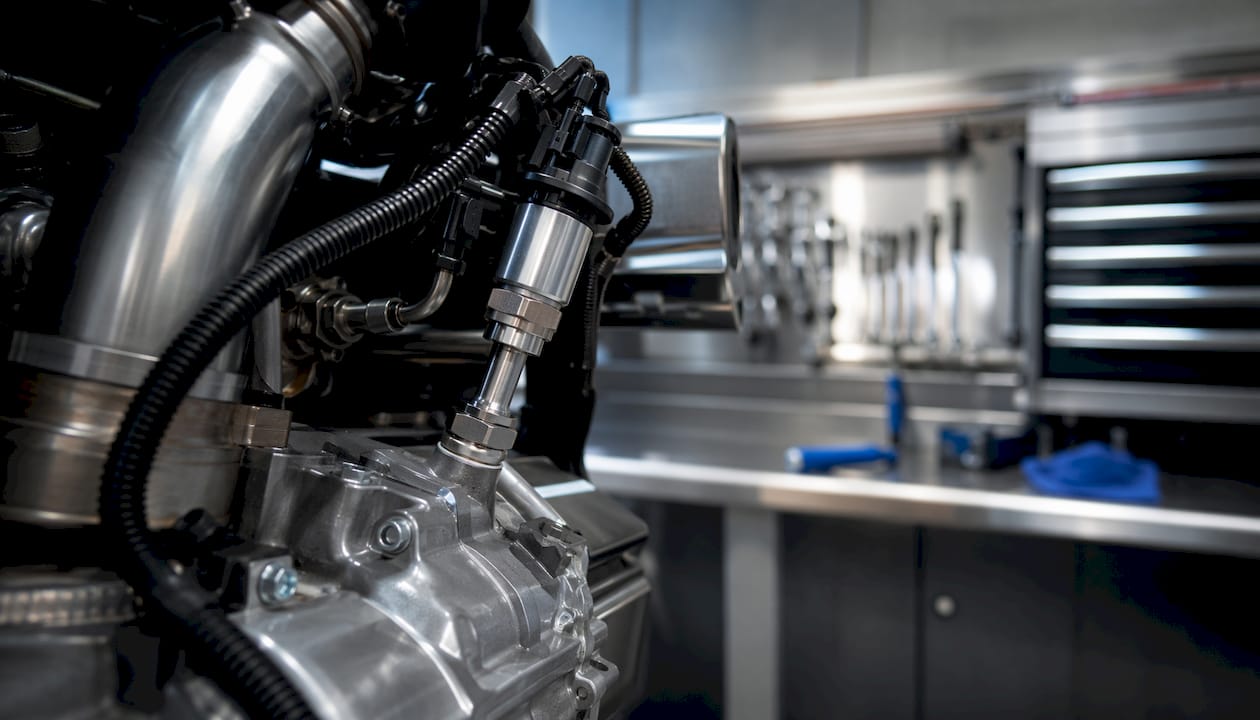
Your engine’s ECU reads NOx sensor data in real time and calculates exactly how much DEF the dosing injector needs to fire. Higher exhaust NOx means more DEF. Lower NOx means less. There is no fixed timer or per-mile schedule.
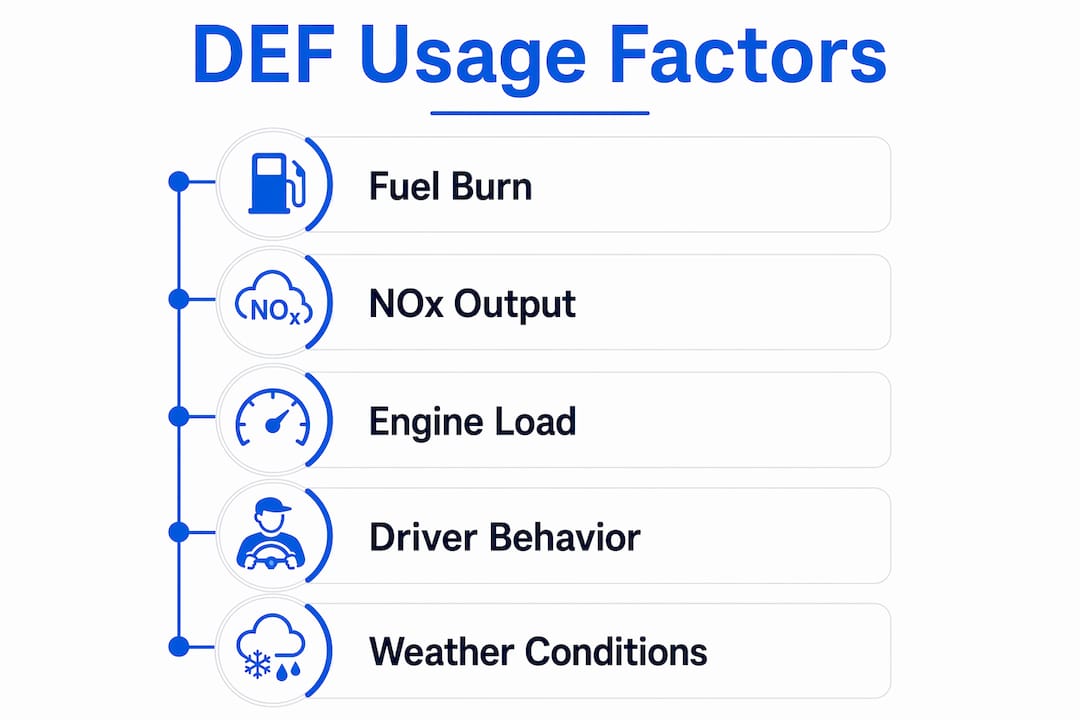
That control loop is why DEF consumption is proportional to fuel burn rather than distance traveled. When the engine works harder, it burns more fuel, produces more NOx, and the SCR system responds by injecting more DEF. Steady highway cruising keeps NOx output relatively stable, so DEF use stays near the low end of the range. Stop-and-go city driving, heavy towing, and high-RPM acceleration all push NOx up and pull DEF consumption with them.
Manufacturer calibration adds another layer of variation. Two trucks with similar displacement can dose DEF differently because one OEM tunes the SCR system more aggressively to stay well below emissions limits, while another doses more conservatively and relies on additional emissions hardware. Software updates from the dealer can shift that calibration, which is why DEF use sometimes changes after a service visit with no obvious mechanical cause.
Operational factors that push DEF consumption up or down
Engine load is the single biggest lever. Here are the factors ranked by typical impact on DEF consumption:
- Towing and payload weight: A loaded truck climbing grades runs hotter, produces more NOx, and doses more DEF. Vocational trucks that consistently run at or near gross vehicle weight tend toward the 3% end of the range.
- Idle time and PTO use: Extended idling keeps the engine running without moving the vehicle, so DEF consumption measured per mile looks artificially high. Refrigeration units, hydraulic PTOs, and job-site equipment running at idle can consume significant DEF against very few odometer miles.
- City driving vs. steady highway: Stop-and-go traffic creates variable exhaust temperatures and frequent acceleration events, both of which increase NOx output. Highway driving at consistent speeds is the most DEF-efficient duty cycle.
- Aggressive acceleration and high RPMs: Hard throttle inputs spike NOx production. Drivers who accelerate smoothly and maintain steady speeds use measurably less DEF than those who drive aggressively on the same route.
- Engine displacement and horsepower: A 15-liter engine moves more exhaust than a 13-liter engine doing identical work, so absolute DEF volume is higher even when the percentage ratio stays similar. Light-duty pickups with smaller diesel engines use less DEF in raw gallons than Class 8 trucks, though the percentage relationship holds.
Driver behavior is a controllable variable that fleet managers often underestimate. Training drivers to reduce unnecessary idling, avoid aggressive acceleration, and maintain steady highway speeds can shift a fleet’s average DEF consumption noticeably toward the lower end of the 2–3% range. Vocational fleets with heavy towing or frequent stops should budget closer to 3–3.5%; long-haul highway operations can often hold near 2%.
Typical DEF-to-diesel ratios and how to calculate your fleet’s needs
The 2–3% rule is reliable for initial budgeting. Translated into practical terms: 1 gallon of DEF per 50 gallons of diesel at 2%, or 1 gallon per 33 gallons of diesel at 3%. Some light-duty diesel owners tracking carefully have reported lower ratios of DEF per diesel, confirming that fleet-level tracking can refine these estimates significantly.
DEF consumption conversion table
| DEF % of diesel | Gallons DEF per 100 gal diesel | Gallons DEF per 1,000 mi at 6 mpg | Gallons DEF per 1,000 mi at 8 mpg | Gallons DEF per 1,000 mi |
|---|---|---|---|---|
| 1.5% | 1.5 gal | 2.5 gal | 2.5 gal | 1.5 gal |
| 2.0% | 2.0 gal | 3.75 gal | 2.5 gal | 2.0 gal |
| 2.5% | 2.5 gal | 4.2 gal | 4.2 gal | 2.5 gal |
| 3.0% | 3.0 gal | — | — | 3.0 gal |
| 3.5% | 3.5 gal | — | — | 3.5 gal |
Three worked examples:
-
Heavy Class 8 truck, 6 mpg, 2.5% DEF rate: Burns 167 gallons of diesel per 1,000 miles. DEF needed: 4.2 gallons per 1,000 miles. A standard 2.5-gallon jug lasts roughly 595 miles under these conditions.
-
Medium-duty vocational truck, 8 mpg, 3.0% DEF rate: Burns 125 gallons per 1,000 miles. DEF needed: 3.75 gallons per 1,000 miles. A 2.5-gallon jug lasts about 667 miles.
-
Light-duty pickup, 20 mpg, 2.0% DEF rate: Burns 50 gallons per 1,000 miles. DEF needed: 1.0 gallon per 1,000 miles. A 2.5-gallon jug covers roughly 2,500 miles.
For fleets with mixed assets and varying duty cycles, the DEF Calculator at Defsales lets you plug in your actual MPG and estimated DEF percentage to get a fleet-specific consumption estimate rather than relying on generic averages. The DEF consumption per diesel gallon guide also walks through fleet-level budget examples in detail.
DEF tank sizes and how far they actually take you
DEF tank capacity scales roughly with fuel tank size, and manufacturers intentionally leave refill interval guidance vague in owner’s manuals because actual usage depends on too many variables to specify precisely. The table below gives realistic estimates by vehicle class.
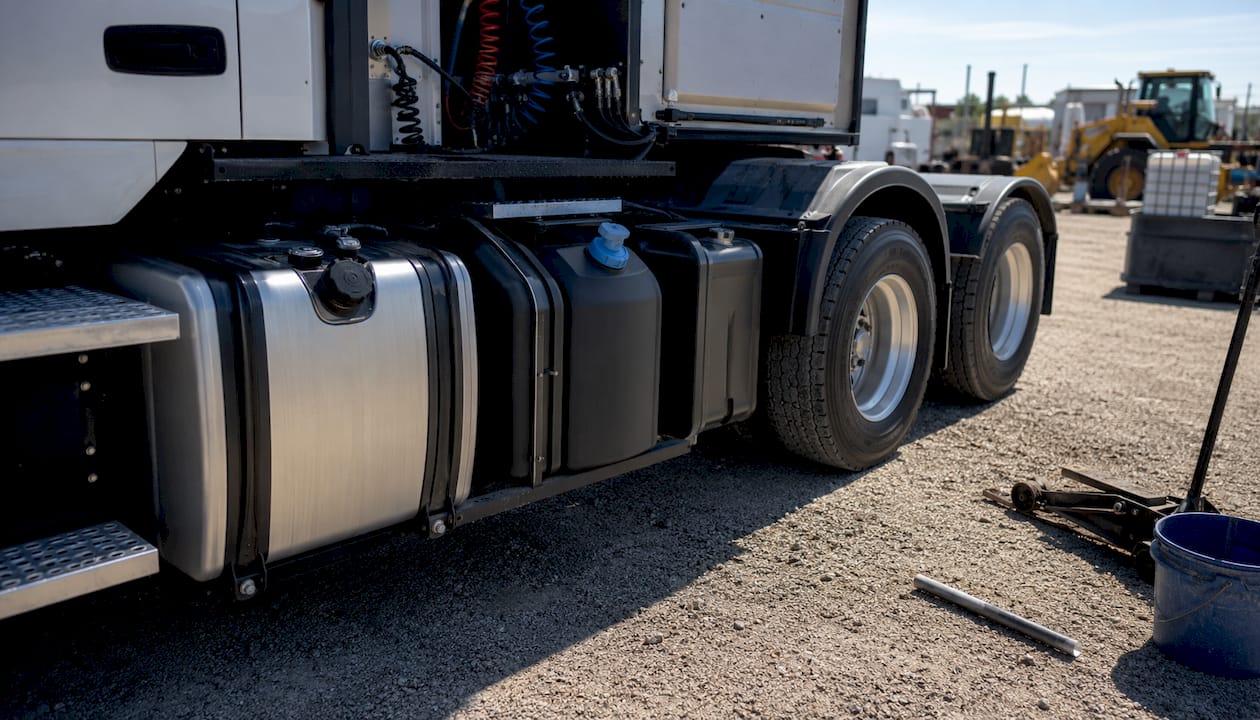
DEF tank capacity and estimated refill intervals
| Vehicle class | Typical DEF tank | Miles between fills (mixed use) | Miles between fills (heavy towing/load) |
|---|---|---|---|
| Light-duty pickup (e.g., 3/4-ton diesel) | 5–8 gal | — | — |
| Heavy-duty long-haul (Class 8) | 15–25 gal | — | ~750 mi |
The MotorTrend Silverado ZR2 Duramax test data fits this pattern exactly: 3,276 miles on the first fill under mixed use, dropping to roughly 750 miles when towing. That range is not unusual for a light-duty diesel under tow loads.
A few practical points worth noting:
- Always verify your specific model’s DEF tank size in the owner’s manual. Manufacturers sometimes change tank sizes between model years or trim levels.
- Telematics systems can confirm actual refill intervals across your fleet and flag vehicles that are consuming DEF faster than their class average.
- For high-idle assets, track DEF against engine hours rather than miles. A truck idling eight hours a day on a job site will burn through DEF with almost no odometer movement.
How weather, temperature, and altitude affect DEF use and storage
Cold weather does not directly increase DEF consumption, but it does affect SCR system behavior. DEF freezes at approximately 12°F (minus 11°C), and most modern trucks include SCR heaters that thaw the DEF tank before dosing begins. During the warm-up period, dosing may be temporarily delayed or altered, which can show up as slightly erratic DEF gauge readings in very cold conditions.
Heat is a bigger storage concern than cold. UV exposure and temperatures above 86°F (30°C) degrade DEF quality over time by breaking down the urea concentration. ISO 22241 sets the quality standard for DEF composition, and fluid that has degraded below spec can cause the SCR system to inject more fluid to compensate for lower urea effectiveness, effectively increasing apparent consumption. Store DEF in a shaded, temperature-controlled area and use sealed containers to prevent contamination.
Altitude has a smaller but real effect. Thinner air at high elevation changes combustion dynamics and can shift NOx production depending on engine calibration and load. Trucks running mountain routes regularly may see slightly different DEF consumption patterns than those operating at sea level, though the effect is usually minor compared to load and duty-cycle differences.
Pro Tip: Keep a DEF storage compliance checklist at every storage point on your site. Catching a degraded batch before it goes into a vehicle is far cheaper than diagnosing an SCR fault after the fact.
Winter and summer storage checklist:
- Store DEF between 12°F and 86°F whenever possible; avoid prolonged exposure outside this range
- Keep containers sealed and away from direct sunlight
- Use dedicated DEF-compatible dispensing equipment (stainless steel or high-density polyethylene) to prevent contamination
- Label storage containers with fill date and test quality if fluid has been stored more than 12 months
- In freezing climates, use heated dispensing equipment or bring containers indoors before use
How to monitor DEF use and estimate future consumption
Accurate monitoring starts with consistent logging. Without it, you are guessing at consumption and reacting to derates instead of preventing them.
- Read the dash DEF gauge and ECU counters at every fuel stop. Most modern trucks display estimated DEF range alongside fuel range. Log both.
- Record DEF added at each fill. Note the date, odometer reading, and gallons added. This gives you a per-fill consumption rate you can compare against fuel invoices.
- Reconcile DEF against fuel monthly. Divide total DEF gallons by total diesel gallons for the period. If the ratio drifts above 3.5% or below 1.5%, investigate before it becomes a derate.
- Use engine hours for high-idle assets. Odometer miles are misleading for trucks that idle heavily. Track DEF per engine hour instead, and set a threshold for refill based on hours rather than miles.
- Set telematics alerts for abnormal DEF consumption. Geotab and similar fleet telematics platforms can correlate fuel burn to DEF use across your entire fleet and flag individual vehicles that deviate from their baseline. That kind of automated monitoring catches a failing dosing injector or degraded DEF batch long before the driver notices a warning light.
For baseline estimation, multiply expected fuel consumption by your fleet’s typical DEF percentage. If a truck burns 500 gallons of diesel per month and your fleet averages 2.5%, budget 12.5 gallons of DEF for that asset. Apply a multiplier for known duty-cycle deviations: heavy towing or high-idle operations can push consumption 25–50% above the baseline percentage, so adjust accordingly. The fleet fuel economy and DEF guide at Defsales covers these multipliers in more detail.
Diagnosing sudden DEF consumption spikes
A sudden increase in DEF consumption, or a DEF range that drops faster than expected, usually has one of a handful of causes. Work through this checklist before assuming the SCR system needs major repair.
Likely causes to check first:
- Degraded or contaminated DEF: Heat, UV exposure, or a contaminated container can reduce urea concentration below the ISO 22241 spec. The SCR system may inject more fluid to compensate, which looks like a consumption spike. Test the fluid with a DEF refractometer before anything else.
- Dosing injector fault: A leaking or stuck-open injector delivers more DEF than commanded. Check for fault codes and inspect the injector for physical damage or deposits.
- NOx sensor fault: A faulty upstream or downstream NOx sensor can feed the ECU incorrect data, causing it to overdose. This often triggers a diagnostic trouble code alongside the consumption change.
- SCR heater failure: In cold weather, a failed SCR heater can prevent proper warm-up, causing erratic dosing behavior and apparent overconsumption.
- Recent software recalibration: If DEF use changed after a dealer service visit, request the ECU update log. OEM software updates can shift dosing strategies, and that change may be intentional or may require a follow-up calibration.
- Increased idle or PTO use: A change in operations (a new job site, added equipment) can increase engine hours without adding miles, making per-mile DEF consumption look inflated.
Red flags that need immediate attention:
- DEF range drops by hundreds of miles overnight with no change in operations
- SERV or DEF-system fault codes appear alongside the consumption change
- The DEF gauge reads empty faster than the refill log suggests it should
For storage-related issues, the DEF storage mistakes guide at Defsales covers the most common contamination and degradation scenarios fleet managers encounter.
Fleet strategies to control DEF costs and stabilize supply
Controlling DEF costs is mostly about reducing the variability that drives consumption toward the high end of the range, and then matching your supply cadence to your actual demand.
Operational controls:
- Train drivers to minimize unnecessary idling, avoid hard acceleration, and maintain steady highway speeds. Even modest improvements in driving behavior shift average consumption toward 2% rather than 3%.
- Plan routes to favor steady-speed miles where possible. A route that avoids heavy stop-and-go traffic saves both diesel and DEF.
- Schedule DEF checks at every fuel stop, not just when the warning light appears. Running low on DEF triggers derates that cost far more in downtime than a proactive top-off.
- For high-idle assets, set engine-hour-based refill thresholds and track them separately from your road fleet.
Supply-side controls:
Bulk delivery and on-site storage are the most effective ways to smooth variable DEF demand. A bulk tank or tote on-site means drivers top off at the yard rather than hunting for DEF at a truck stop, which also reduces the risk of using off-spec fluid from an unknown source. Periodic quality testing of stored DEF, especially in summer, catches degradation before it reaches a vehicle.
Pro Tip: Tie your replenishment order to telematics data rather than a fixed calendar schedule. If your fleet ran heavier loads last month, your DEF burn was higher. Ordering based on actual consumption data prevents both stockouts and excess inventory.
The bulk DEF cost savings guide at Defsales breaks down the per-gallon cost difference between packaged and bulk DEF, which widens significantly as fleet size grows.
What industry tests and fleet data confirm about DEF variation
The MotorTrend long-term Silverado ZR2 Duramax test is one of the most detailed published records of real-world DEF variability. The key finding: DEF range shifts almost exactly with fuel economy changes. When the truck got worse fuel economy due to towing or headwinds, DEF range dropped proportionally. The first refill at 3,276 miles under mixed use versus roughly 750 miles under tow load illustrates the four-to-one swing that duty cycle can produce in a single vehicle.
PartsForTrucks calls the 2–3% rule reliable for budgeting but recommends that operators track and reconcile actual usage for their specific fleet to refine forecasts. That recommendation holds up in practice: community-reported tracking on specific engine platforms has shown ratios as low as 1.15–1.25 gallons of DEF per 100 gallons of diesel, confirming that some light-duty engines run toward the conservative end of the range under favorable conditions.
Foster Fuels and similar fleet supply operators note that DEF tank sizes often correlate to fuel tank capacity, and that owner manuals intentionally avoid specific refill intervals because the variables are too numerous to generalize. That is consistent with the ISO 22241 framework, which governs DEF composition and quality but does not prescribe dosing rates, since those are determined by each OEM’s SCR calibration.
Key data points from real-world sources:
- Mixed-use DEF refill interval typical of thousands of miles as shown in the MotorTrend Silverado ZR2 Duramax test
- Heavy-tow DEF refill interval significantly shorter when towing heavy loads as shown in the MotorTrend Silverado ZR2 Duramax test.
- Standard budgeting ratio: 2–3% of diesel consumed, with a reasonable variation range of 1.5–3.5%
- Light-duty tracking data: some platforms report as low as 1.15–1.25 gallons DEF per 100 gallons diesel under favorable conditions
Defsales resources, including the DEF Calculator and storage guides, are built around this same data foundation, giving fleet managers tools to apply these findings to their specific assets rather than relying on generic industry averages.
Key Takeaways
DEF consumption tracks NOx output and engine load, not miles, so duty cycle is the primary variable fleet managers need to monitor and control.
| Point | Details |
|---|---|
| Core rule of thumb | Budget 2–3% of diesel volume as DEF; expect 1.5–3.5% depending on load and duty cycle. |
| Duty cycle drives the range | Towing and high-idle operations can push DEF consumption to four times the rate of steady highway driving. |
| Monitor by engine hours for idle assets | High-idle trucks and PTO equipment should be tracked in DEF per engine hour, not per mile. |
| Use ISO 22241-compliant fluid | Degraded or off-spec DEF can increase dosing and cause SCR faults; verify quality especially after summer storage. |
| Defsales tools for fleet planning | The DEF Calculator and fleet guides at Defsales help size bulk supply and match replenishment cadence to actual consumption data. |
Reliable DEF supply starts with knowing your actual consumption
Once you know your fleet’s real DEF consumption range, the next step is making sure supply never becomes the constraint. Anytime Fuel Pros delivers bulk DEF directly to your site, whether that means a tote for a small yard, a bulk tank for a large fleet, or scheduled wet-hosing delivery for operations in San Antonio, Austin, Dallas, and Salt Lake City. Every delivery uses ISO 22241-compliant fluid, so you are not guessing at quality from an unknown source.
Before you call for a quote, run your numbers through the DEF Calculator at Defsales to get a consumption estimate based on your actual MPG and duty cycle. Then use the DEF delivery near me page to request a delivery quote or set up a scheduled replenishment cadence tied to your telematics data. Defsales also covers bulk vs. packaged DEF options in detail if you are still deciding on the right format for your operation.
Useful sources and tools
Use these references to validate numbers, check storage requirements, or arrange supply:
- MotorTrend Silverado ZR2 Duramax long-term test — Real-world DEF refill intervals under mixed and towing conditions; the best published example of duty-cycle variability. Start here if you want to understand the range.
- PartsForTrucks DEF consumption guide — Detailed breakdown of the 2–3% rule, engine displacement effects, and SCR calibration differences. Use this to explain the baseline to your team.
- Foster Fuels DEF regulations guide — Covers DEF tank sizing, regulatory context, and why owner manuals stay vague on refill intervals.
- Proformance Supply DEF consumption guide — Step-by-step instructions for calculating DEF from fuel consumption numbers; practical for operators setting up a tracking system.
- Defsales DEF Calculator — Interactive tool: enter your MPG and DEF percentage to get a fleet-specific consumption estimate. Use this before ordering bulk supply.
- Defsales storage temperature guide — ISO 22241 storage requirements and handling best practices; consult this before setting up on-site storage.
- Defsales types of DEF delivery services — Explains bulk tanks, totes, and scheduled delivery options; use this when evaluating supply formats for your operation.