
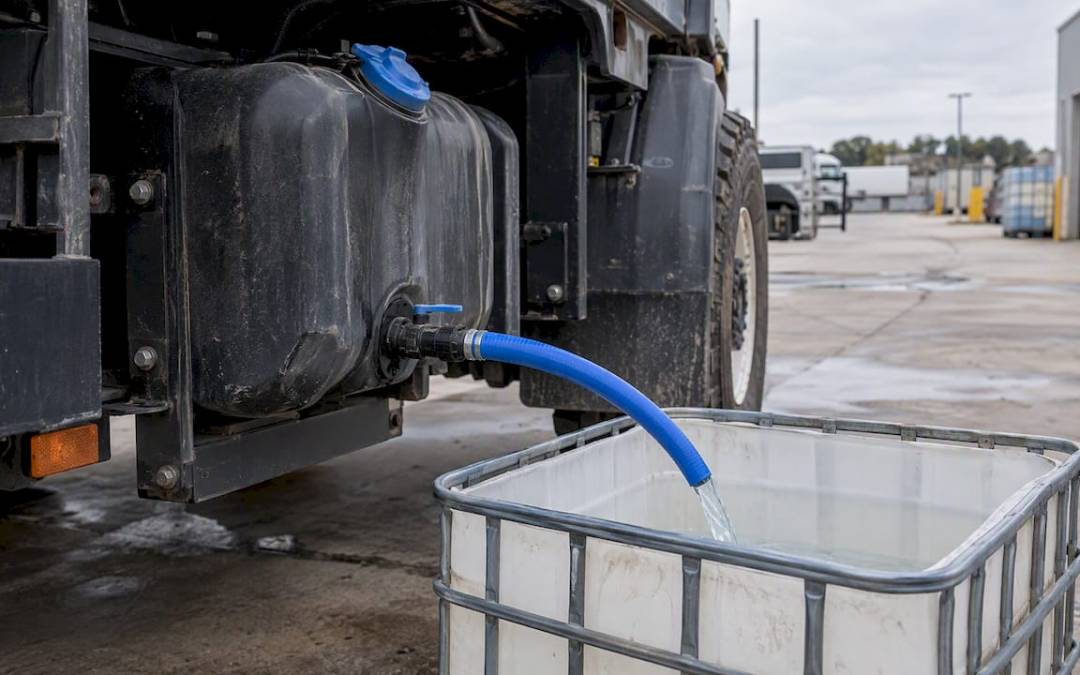
The fix for contaminated DEF is to stop running the equipment, drain the bad fluid, service the parts it touched, refill with certified DEF and confirm dosing with the maker’s scan tool. There is no additive, filter or dilution trick that makes bad DEF good again. Cummins says chemical contamination cannot be removed from DEF and that contaminated fluid must be replaced. The rest of this guide covers how to confirm the problem is real, what the cleanup involves, what to do if DEF went into the diesel tank, and how to stop it happening again.
TL;DR
- Stop operating once you suspect contamination. Do not add an additive, and do not try to dilute the fluid.
- Physical particles can sometimes be filtered out. Chemical contamination cannot, so mixed or unknown fluid gets drained and replaced.
- A quality fault right after a refill is not proof of bad fluid. Read scan data first, because frozen DEF, bubbles or low exhaust temperature can trigger false readings.
- Refill only with DEF that meets ISO 22241-1 and your engine maker’s specification, then verify dosing with the OEM tool.
- Deleting the SCR system to avoid a derate is not a fix. It is tampering under federal rules.
Table of Contents
- Confirm it is contamination before you drain anything
- Know which kind of contamination you have
- How to fix contaminated DEF in the tank: step by step
- If DEF went into the diesel tank
- What the truck will do while you sort it out
- Why deleting the system is not the answer
- Preventing the next event at the transfer point
- Getting clean replacement DEF to the site
- FAQ
- Sources
Confirm it is contamination before you drain anything
Draining a tank of good DEF wastes money and downtime. Before you commit, rule out a false alarm.
EPA’s March 2026 guidance on DEF quality monitoring makes the point plainly. A poor-quality indication is not automatically proof that the fluid is bad. According to EPA’s guidance on alternate sensor technologies, NOx-based quality monitoring generally needs the system to be dosing at sufficient exhaust temperature. Urea-quality sensors can be inaccurate when there are bubbles, and they cannot monitor frozen fluid.
So a fault that appears just after a refill, in cold weather or at light load deserves a diagnostic pass first. Our SCR system self-diagnosis steps walk through that sequence. Check these items:
- Operating conditions. Was the fluid frozen or recently thawed? Was the engine running at low load with a cold exhaust?
- Refill history. Did a fault appear right after topping off? Which container, pump or nozzle did the fluid come from?
- Scan data. Pull the fault codes and quality readings with the OEM tool. Record them before clearing anything.
- The fluid itself. Look at the DEF. It should be clear, with no color, odor of fuel or oil, floating debris or sludge. A refractometer can flag a concentration problem, but it does not prove contaminated fluid is safe. Cummins says chemical contamination can be impossible to remove, so a good reading does not clear fluid you suspect was mixed.
If the symptoms and the fluid both point to contamination, move on. Our guide to DEF contamination symptoms in diesel engines covers the warning signs in more detail.
Know which kind of contamination you have
Cummins describes three types of DEF contamination: hard particles, chemical contamination and concentration problems. The type decides the fix.
| Type | Typical cause | What it damages | Fix |
|---|---|---|---|
| Hard particles | Dust, dirty funnels, open tank necks, crystallized residue | Pumps and dosers | Drain, replace or clean filters and tank components under the maker’s procedure, refill |
| Chemical | Fuel, oil, detergent, coolant, wrong fluid in the tank | SCR catalyst and the whole DEF path | Drain and replace the fluid, inspect and service or replace affected parts |
| Concentration | Water added, or improper evaporation raising the urea level | Reduced performance or wrong dosing | Drain and replace with correct-strength DEF |
The key distinction is between particles and chemistry. Filtration can remove hard particles. It cannot remove dissolved chemicals, which is why “run it through a filter” is not a safe fix for mixed or unknown fluid. Chemical contamination can also damage the SCR catalyst, and that is the expensive part of a bad event.
Water is the most common concentration problem. If a crew topped off with a hose or diluted a thickened mix, read our 7-step fleet cleanup for water in DEF tanks.
How to fix contaminated DEF in the tank: step by step
The sequence below follows the approach Cummins and EPA guidance describe. Your engine maker’s service procedure always controls the details, since tank design, heater lines and sensor locations vary by model.

1. Stop and isolate
Shut the equipment down once you suspect contamination, a warning, abnormal fluid or a mixed-fluid event. Keep running it and you push bad fluid through the pump, lines and doser, and potentially to the catalyst. Tag the machine and keep the suspect container or nozzle so you can trace the source.
2. Do not reach for an additive
There is no approved universal additive that cleans contaminated DEF or restores off-spec fluid. Diesel additives, solvents, detergents, anti-gel products and plain water are not substitutes for draining and servicing the system. Adding water also changes the urea concentration, which creates a second problem on top of the first.
3. Drain the DEF
Pump or drain the tank into a dedicated, labeled container. Treat it as waste until you know what it is. Wear eye and skin protection. Cummins notes that DEF is not hazardous, but short-term exposure can mildly irritate eyes and skin. Check your local rules for disposing of fluid that was mixed with fuel, oil or chemicals, and do not pour it on the ground.
4. Clean or replace what the fluid touched
For a particle problem, that usually means the tank, suction filter and any screens. Where the fluid was chemically contaminated, expect to inspect and possibly replace the supply module, lines, filter and doser. Follow the OEM procedure on which parts are serviceable and which are replaced. For a lightly contaminated tank, a rinse with clean water is typically part of that procedure, but only once the tank is fully empty and only as the service procedure allows, so every trace is out before the new fluid goes in.
5. Refill with certified DEF
The replacement must meet your engine maker’s specification and the quality requirements in ISO 22241-1, the standard that sets the quality characteristics SCR systems need. Check the label for ISO certification, and use dedicated, clean dispensing equipment. Our ISO 22241 basics for fleet professionals explains what to look for on a label.
6. Prime, clear codes and verify
Prime the system as the procedure requires, clear the codes, then verify dosing and NOx performance with the OEM scan tool. A clean road test is not enough. You want to see the system dose, the readings settle and the fault stay cleared under real load and temperature.
If DEF went into the diesel tank
This is the reverse mistake, and it is the one behind most of the horror stories in search results. DEF is mostly water and urea. In a fuel system it lacks lubricity and can corrode and damage fuel components. Roadside guides agree on the first move: do not start the engine. Starting it circulates the fluid through pumps and injectors.
If the engine has not run:
- Leave the key off and get the unit towed or moved without running it.
- Have the fuel tank drained and the lines flushed by a qualified shop.
- Replace the fuel filters and refill with fresh diesel.
If the engine has run, the shop has to inspect the pump, lines and injectors, and the scope can grow quickly. Costs vary widely by engine and how far the fluid traveled, so get a written diagnosis before authorizing work. Our DEF cross-contamination guide for fleet managers covers both directions and how to train crews to avoid them.
What the truck will do while you sort it out
An SCR controller that sees a quality fault can issue warnings and then an inducement, a derate that limits torque or speed. Timing and severity depend on the manufacturer and the software.
EPA revised its heavy-duty expectations in August 2025. EPA’s revised guidance lists inducement stages for the specified heavy-duty context:
| Stage | Trigger | Effect |
|---|---|---|
| Initial | 650 miles or 10 hours | 15% torque reduction |
| Secondary | 4,200 miles or 80 hours | 30% torque reduction |
| Final | 8,400 miles or 160 hours | Speed limited to 25 mph |
Treat those as regulatory figures for that category, not a promise for every engine. Your own unit may derate sooner or later. The practical lesson: a contamination fault gives you a window, but it is a short one. Do the diagnosis and repair rather than coasting through it.
Why deleting the system is not the answer
When a repair quote is high, someone usually asks about removing the DEF system. For certified on-road vehicles and nonroad engines, that is generally illegal. EPA’s tampering and defeat device enforcement alert names SCR systems, NOx sensors, urea-quality sensors and related controls among the protected emissions components. Removing them, or selling and installing defeat devices, is prohibited under the Clean Air Act.
Repair is a different act. Restoring a faulty DEF system, using equivalent compliant parts and installing an approved manufacturer software update are all repairs. EPA’s recent right-to-repair actions concern access to service information and tools, and they do not legalize deletes. A delete also leaves you with a vehicle you may not be able to sell, register or insure cleanly, so the quote you are avoiding is rarely the real saving.
Preventing the next event at the transfer point
Most contamination happens where fluid moves: at the tank neck, the container, the pump and the nozzle. Cummins’ DEF quality and maintenance brochure points to practical habits that stop repeat failures:
- Clean the tank neck, container and nozzle before every fill.
- Keep the nozzle in the tank while filling to cut drips, and protect open ports during service.
- Use dedicated DEF containers and equipment. Never reuse fuel, oil or chemical containers.
- Keep oil, fuel, dust and detergents away from DEF storage.
- Inspect tank-neck and vent filters, and remove crystallized DEF.
- Use a closed dispensing system in dirty environments.
- Keep records of fills, so a fault can be traced to a batch.
Storage matters too. ISO 22241-3 covers handling, transportation and storage practices meant to preserve the specified quality of the fluid, and it is a useful baseline for a written yard procedure. For a quick refresher on the basics, see our fleet operator’s guide to diesel exhaust fluid.
For fleets, the cheapest control is often moving away from open jugs and funnels toward a closed bulk or tote system with a dedicated pump. The tradeoffs are laid out in our guides to bulk DEF versus totes and bulk DEF versus jugs.
Getting clean replacement DEF to the site
A contamination cleanup ends with a refill, and the refill is only as good as the fluid and equipment behind it. If you need certified DEF delivered to a yard or job site, our DEF delivery and bulk diesel questions answered page explains how delivery works and what to ask a supplier. You can request delivery and quotes through our supply route, and the DEF calculator helps you size a tank or resupply schedule before you call.
FAQ
Can contaminated DEF be filtered and reused?
Only hard-particle contamination can be filtered, and even then the tank and components need servicing under the engine maker’s procedure. Chemical contamination cannot be filtered out, so mixed or unknown fluid should be drained and replaced.
Is there an additive that cleans a DEF system?
No approved universal additive cleans contaminated DEF or restores off-spec fluid. Diesel additives, solvents, detergents and water are not substitutes for draining and servicing the system, and water also throws off the urea concentration.
Is it legal to delete the DEF system?
Generally no for certified road vehicles and nonroad engines. EPA treats removing or disabling SCR and related controls as tampering under the Clean Air Act. A real repair or an approved manufacturer software update is allowed, because it restores the system to working order.
My truck flagged DEF quality right after a refill. Is the fluid bad?
Not necessarily. EPA notes that frozen fluid, bubbles, a lack of dosing or low exhaust temperature can make a quality reading unavailable or wrong. Read the scan data and run the OEM diagnostics before you dump good DEF or replace parts.
What should I do if I put DEF in the diesel tank?
Do not start the engine. Have the unit moved without running it, then have the fuel tank drained, the lines flushed and the filters replaced by a qualified shop. If the engine already ran, ask for an inspection of the pump and injectors before agreeing to a scope of work.
Sources
- DEF Purity and Cleanliness, Cummins
- DEF Quality and Maintenance, Cummins
- ISO 22241-1:2019, Quality requirements
- ISO 22241-3:2017, Handling, transportation and storage
- EPA, DEF Quality Monitoring Using Alternate Sensor Technologies (March 2026)
- EPA, Revised SCR guidance (August 2025)
- EPA, Aftermarket Defeat Devices and Tampering enforcement alert
- What to Do If You Accidentally Put DEF in Your Diesel Tank