

A “SCR efficiency low” code means your engine control module compared the inlet and outlet NOx readings and found conversion falling below the calibrated threshold, typically within a certain calibrated range. Before you touch the catalyst, connect a scan tool and pull live inlet and outlet NOx data. Most of these faults trace back to upstream issues like sensor drift, dosing problems, or exhaust leaks rather than catalyst failure.
TL;DR:
- Most SCR efficiency faults are caused by upstream issues like sensor drift, dosing problems, or exhaust leaks, rather than catalyst failure.
- Running a NOx sensor cross-check before replacing parts can prevent up to a quarter of unnecessary catalyst replacements.
- Dosing system faults, contaminated DEF, and sensor drift account for about 92 percent of these faults, making upstream diagnostics critical.
- Confirming stable NOx readings, proper DEF concentration, and exhaust integrity reduces misdiagnosis and unnecessary repairs.
- Catalyst replacement should only occur after confirmed physical damage and thorough verification of upstream correction efforts.
Table of Contents
- How SCR Efficiency Is Measured and What the Code Signals
- Ranked Root Causes and How to Tell Them Apart
- Step-by-Step Diagnostic Checklist for a Low SCR Efficiency Fault
- Common Fixes, Repair Order, and What They Cost
- Protecting SCR Efficiency Through Better DEF Handling
- When the Catalyst Actually Needs Replacing
- Reliable DEF Supply Prevents the Faults You’re Chasing
- Sources
- FAQ
How SCR Efficiency Is Measured and What the Code Signals
The ECM doesn’t guess at SCR performance. It reads NOx concentration entering the catalyst from the inlet sensor, then reads NOx concentration leaving the catalyst from the outlet sensor, and calculates a conversion percentage from the difference. When that percentage drops below the OEM’s calibrated threshold, the system logs an efficiency fault even though nothing may be physically wrong with the catalyst itself.
Healthy systems typically convert a majority of the inlet NOx, depending on the engine family and emissions tier. Drop below that floor and you’ll see one of a handful of familiar codes:
- SPN 4360 — general SCR performance/efficiency fault
- SPN 4364 / FMI 18 — often tied to NOx sensor drift or a below-normal signal
- P20EE — the common passenger and light-duty diesel equivalent for SCR catalyst efficiency below threshold
Each of these tells you the same basic thing: outlet NOx is too high relative to inlet NOx. It doesn’t tell you why, and that’s where the real diagnostic work starts.
Ranked Root Causes and How to Tell Them Apart
Roughly 92 percent of SCR efficiency faults come from something upstream of the catalyst, not the catalyst itself, according to DTC Hub’s repair data. That number should reset how you approach every one of these faults. Work through causes in this order:
- NOx sensor drift. A drifting outlet sensor reports NOx levels that don’t match reality, making a healthy catalyst look inefficient. Run a NOx sensor cross-check by comparing both sensors’ readings against known reference values at idle and under load; a consistent offset points to a bad sensor, not a bad catalyst.
- DEF dosing issues. A clogged doser tip or an unstable pump pressure reduces the amount of urea actually reaching the exhaust stream, even when the system commands a normal dose.
- DEF contamination or dilution. Water-diluted or contaminated DEF won’t produce the chemical reaction the catalyst needs, no matter how well the hardware works.
- Exhaust leaks. A leak between the catalyst and the outlet sensor lets ambient air dilute the exhaust stream, creating a “ghost” efficiency fault that has nothing to do with actual conversion performance.
- Catalyst poisoning or thermal damage. Sulfation, ammonium bisulfate buildup, or melted substrate from overheating are real failures, but they’re the least common cause and usually show physical evidence under a borescope.
Pro Tip: Run the NOx cross-check before anything else. Catching sensor drift or dilution early avoids up to a quarter of unnecessary catalyst replacements, which is the single most expensive wrong turn in this whole diagnostic chain.
Step-by-Step Diagnostic Checklist for a Low SCR Efficiency Fault
Grab a scan tool with live NOx readout capability, a refractometer, a pressure gauge, and a borescope. Then work through this sequence:
- Log inlet and outlet NOx at steady idle and again under cruise load. A wide, consistent gap between the two under both conditions suggests real conversion is happening; erratic or reversed readings point to a sensor problem.
- Command a doser test and measure actual delivered volume and pressure against the commanded amount. Dosing pressure should stay stable within the pump’s rated range; fluctuation under load usually means a failing pump or a partially clogged injector tip.
- Test a DEF sample with a refractometer. Genuine DEF reads 32.5 percent urea concentration. Anything noticeably off that mark means the tank needs flushing before you chase anything else.
- Pressure test the exhaust system between the catalyst and outlet sensor, and follow up with a borescope inspection of the catalyst substrate for cracking, melting, or plugging.
- Clear the code and run the OEM parked SCR efficiency test, then complete the required road verification, typically 20 to 50 miles at highway speed, before declaring the repair finished. Our self-diagnosis guide walks through each of these steps in more detail if you want a field-ready reference.
Common Fixes, Repair Order, and What They Cost
Fix in the order that matches how often each cause actually shows up, not the order that feels most dramatic.
- NOx sensor replacement or recalibration comes first when your cross-check shows drift. Expect roughly $300 to $1,000 in parts and labor, and it’s almost always cheaper than a catalyst.
- Doser or pump repair, including cleaning or replacing injector tips, falls in a similar $300 to $1,000 range depending on whether you’re replacing the whole unit or just clearing a clog.
- DEF tank flush and refill clears the code quickly when contamination is the cause, but it won’t touch a fault rooted in sensor drift or a mechanical dosing failure, so don’t assume one flush solves everything.
- Catalyst replacement is the last resort, reserved for confirmed substrate damage or poisoning. Budget $2,500 to $4,500 including labor when that’s genuinely where the problem sits.
If conversion stays low after verified dosing and sensor checks come back clean, that’s your signal to escalate to OEM-level diagnostics rather than keep swapping parts.
Protecting SCR Efficiency Through Better DEF Handling
Many upstream issues originate from how DEF is stored and managed before injection; contamination or degradation typically occurs in storage rather than at the dosing pump.
- Store DEF according to ISO 22241 guidelines, keeping it out of direct sunlight and away from temperature extremes.
- Sample and test DEF on a regular schedule rather than waiting for a fault code to force the issue, and keep records for every batch.
- Inspect NOx sensors, the doser, and exhaust flanges on a set cadence rather than only when something throws a code.
- Follow proper freeze and thaw protocols in cold months. DEF freezes around 12°F; improper freeze-thaw handling can concentrate contaminants and affect fluid quality.
Pro Tip: Keep a simple log of DEF lot numbers and refractometer readings at fill-up. When a fault does show up, that log tells you in seconds whether the fluid is the likely culprit.
When the Catalyst Actually Needs Replacing
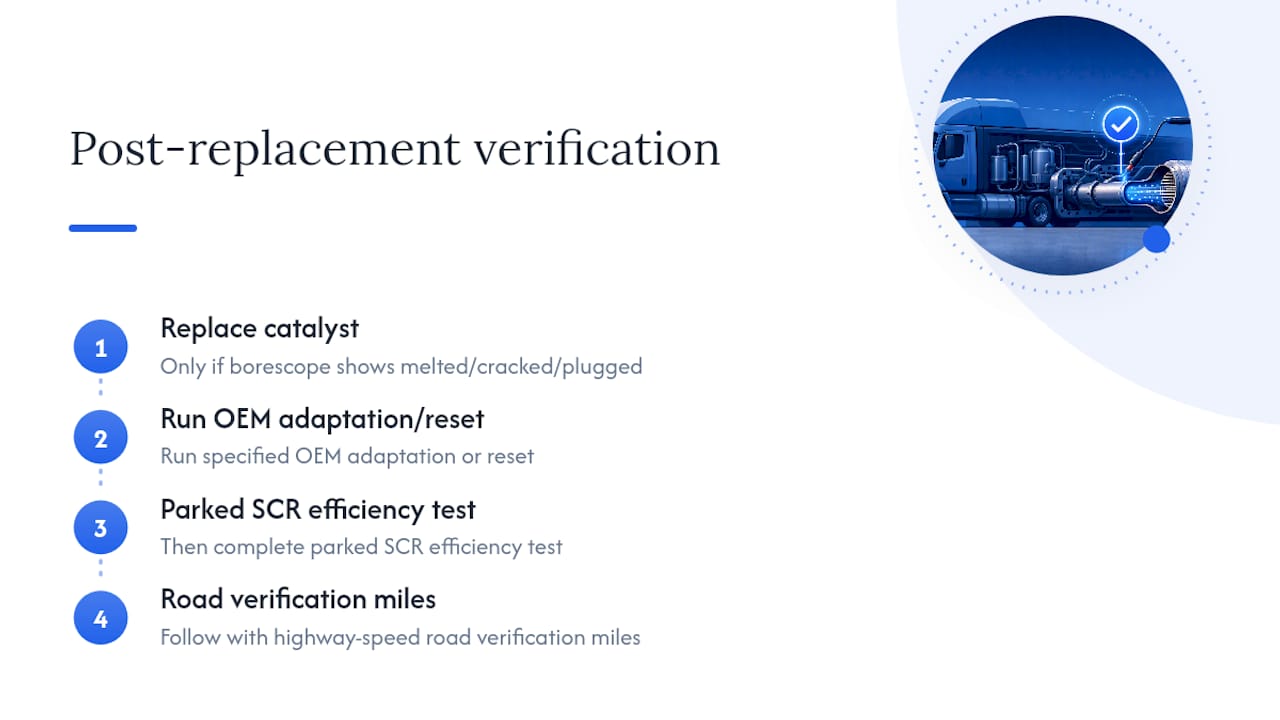
Replace the catalyst only when a borescope shows melted, cracked, or plugged substrate and upstream fixes haven’t moved the needle. If inlet and outlet NOx readings check out normal and dosing is confirmed stable, yet conversion still sits below threshold, the catalyst itself is the remaining variable.
After replacement, run the adaptation or reset procedure your OEM specifies, then complete the parked SCR efficiency test followed by the recommended road verification miles at highway speed. Skipping that verification step is how technicians end up chasing a “repeat” fault that was actually never confirmed fixed in the first place.
Reliable DEF Supply Prevents the Faults You’re Chasing
A lot of the diagnostic work above traces back to one root issue: inconsistent or contaminated DEF quietly degrading dosing accuracy long before a code ever appears. Diluted urea concentration, moisture intrusion during storage, and inconsistent batch quality all show up later as dosing irregularities that look like sensor or pump failures.
This resource aims to give fleets and technicians the information to catch these problems early, and refers readers to suppliers who can remove the supply-side risk entirely. Scheduled bulk delivery with quality-assured DEF means you’re not relying on jugs from a rotating cast of suppliers, and you’re not storing fluid longer than you should just because a delivery got delayed. That consistency is what keeps dosing systems calibrated and NOx conversion where it belongs. If your fleet is chasing repeat SCR faults tied back to fluid quality, request bulk DEF delivery or a quote and get ahead of the next code before it hits the dash.
Sources
For deeper procedure detail, consult the SCR system fault repair guide, the advanced SCR troubleshooting guide, the NOx sensor drift diagnostic writeup, and the OEM parked SCR efficiency test TSB.
- SCR System Fault: How to Fix It (Causes, Codes & Step-by-Step Repair) | DTC Hub
- Master Technician’s Guide to Advanced SCR Troubleshooting – DEFinjector
- How to Fix SPN 4364 FMI 18 – NOx Sensor Drift / SCR Efficiency Low – DieselScanners
FAQ
What Causes Low SCR Efficiency?
The most common causes are NOx sensor drift, DEF dosing problems, contaminated or diluted DEF, and exhaust leaks between the catalyst and outlet sensor. Actual catalyst poisoning or damage accounts for a small share of cases.
How Do I Know if My SCR Catalyst Is Bad?
A failing catalyst exhibits physical signs such as melted, cracked, or plugged substrate upon borescope inspection, and the fault continues after upstream components have been verified functional.
How Long Can I Drive With an SCR System Fault?
Most systems allow limited driving before torque derates and eventual speed limiting kick in, though the exact mileage and severity depend on your engine manufacturer’s emissions strategy. Address the fault as soon as it appears rather than waiting for the derate to force the issue.
What Does SCR Efficiency Mean?
SCR efficiency is the percentage of NOx converted to nitrogen and water as exhaust passes through the catalyst, calculated by comparing inlet and outlet NOx sensor readings. A healthy system typically converts somewhere in the 70 to 85 percent range.