

Effective DEF tank monitoring stops SCR derates and shutdowns before they start, and it does that by combining two separate systems: vehicle-integrated Urea Quality/Level Sensors (UQLS) and depot-level bulk-tank telemetry. Skip either half and you’re guessing. Get both right, and low DEF or off-spec fluid never catches you off guard mid-route or mid-shift. The rest of this guide breaks down the sensors, the materials, the alerts, and how to troubleshoot when something looks wrong.
TL;DR:
- Fleet monitoring must include both vehicle-integrated sensors and depot-level telemetry to accurately track DEF quality and quantity, avoiding guesswork.
- Depot sensors should use materials like 316L stainless steel and FKM seals to prevent contamination and corrosion, with proper installation and overfill protection.
- Alerts must be timely and actionable, with automated responses such as dispenser lockouts and integration into telematics platforms to prevent downtime.
- Troubleshooting involves checking DEF quality first, inspecting wiring, and verifying OEM diagnostic standards before replacing sensors, to reduce false alarms.
- When selecting a system, consider material compatibility, accuracy, connectivity options, alerting reliability, and vendor support to ensure effective fleet-wide DEF management.
Table of Contents
- What Good DEF Tank Monitoring Looks Like: A Fleet Checklist
- Sensors and Telemetry: Level, Temperature, and Quality Sensing Explained
- Materials and Installation: Avoiding Contamination and Corrosion
- Alerts, Alarms, and Integrations: How Monitoring Prevents Downtime
- Troubleshooting and Routine Maintenance for DEF Monitoring Systems
- How to Choose a DEF Tank Monitoring Solution for Your Fleet
- Turning Monitoring Data Into Action
- Sources
What Good DEF Tank Monitoring Looks Like: A Fleet Checklist
Vehicle sensors and bulk-tank sensors do different jobs, and treating them as one system is where a lot of fleets lose track of things. Vehicle UQLS reports level, temperature, and quality to the truck’s onboard computer over the J1939 network. Bulk-tank monitoring watches your depot’s supply, separate from any single vehicle’s dashboard.
A monitoring setup worth trusting hits a few marks:
- Tracks level, temperature, and concentration at the depot tank, not just individual trucks
- Flags concentration outside the ISO 22241 recommended range, not just low volume
- Sends alerts through multiple channels (text, email, or a telematics dashboard) with a defined response time for low-level warnings
- Has a backup sensor or manual dip-stick check for redundancy when telemetry drops
- Logs data regularly for trend reports tied to consumption planning
If your current setup only tells you “empty” after the tank is already empty, it isn’t monitoring. It’s just an alarm.
Sensors and Telemetry: Level, Temperature, and Quality Sensing Explained
A UQLS sits inside the vehicle’s DEF tank and reports level, quality, and temperature together through the J1939 data bus, feeding the SCR system’s fault logic directly. That’s different from bulk-tank sensing, which watches your depot’s supply and has no direct line to any single vehicle’s dashboard.
Depot tanks typically use one of three sensor types:
- Submersible probes, often built with 316L stainless steel housings, giving continuous 4–20mA level output
- Ultrasonic sensors, which measure level without touching the fluid, useful where probe fouling is a concern
- Pressure-based sensors, which infer level from hydrostatic pressure and work well in tall vertical tanks
One example spec worth knowing: the LMP307 submersible probe uses a 316L housing, FKM seals, a 4–20mA output, and holds 0.35% full-scale accuracy, which is the kind of tolerance you want when a few gallons of margin decides whether a route finishes clean.
Telemetry gateways carry that sensor data off-site using cellular modems, LoRa radio for remote yards, or hardwired connections where the depot already has network infrastructure. Real-time DEF tank monitoring pushes level, temperature, and quality data to supervisors continuously, which cuts down on emergency deliveries triggered by surprise empty tanks.
Sensors tell you level and temperature reliably. They don’t always tell you quality with certainty. That’s where a refractometer sample earns its place, confirming the fluid is actually within the 32.5% urea window before you trust a fault code pointing at hardware.
Materials and Installation: Avoiding Contamination and Corrosion
DEF is corrosive to a surprising number of common metals. Brass, copper, and several aluminum alloys degrade on contact with urea solution, and that degradation contaminates the fluid it’s supposed to protect. That’s why sensor and fitting specifications for DEF service call out specific materials rather than leaving it to chance.
Stick to these when installing or replacing components:
- 316L stainless steel for probe housings and wetted fittings
- FKM (fluoroelastomer) seals and gaskets, since standard rubber compounds break down in DEF
- FEP-jacketed cabling anywhere wiring runs through or near the fluid path
Beyond materials, mount sensors so they clear the tank bottom by the manufacturer’s specified gap, vent tanks properly to avoid pressure buildup, and install overfill protection on any bulk tank fed by delivery trucks. Cold-climate yards need freeze protection given that DEF’s freeze point sits around 12°F.
Pro Tip: *During commissioning, run the tank through one full fill-drain cycle before trusting the sensor’s calibration.
Alerts, Alarms, and Integrations: How Monitoring Prevents Downtime
A monitoring system earns its cost when alerts actually change what someone does next, not when they just pile up in an inbox. The OMNTEC monitoring platform and similar setups report level, temperature, and quality flags in real time specifically so a dispatcher can act before a truck rolls out with marginal DEF.
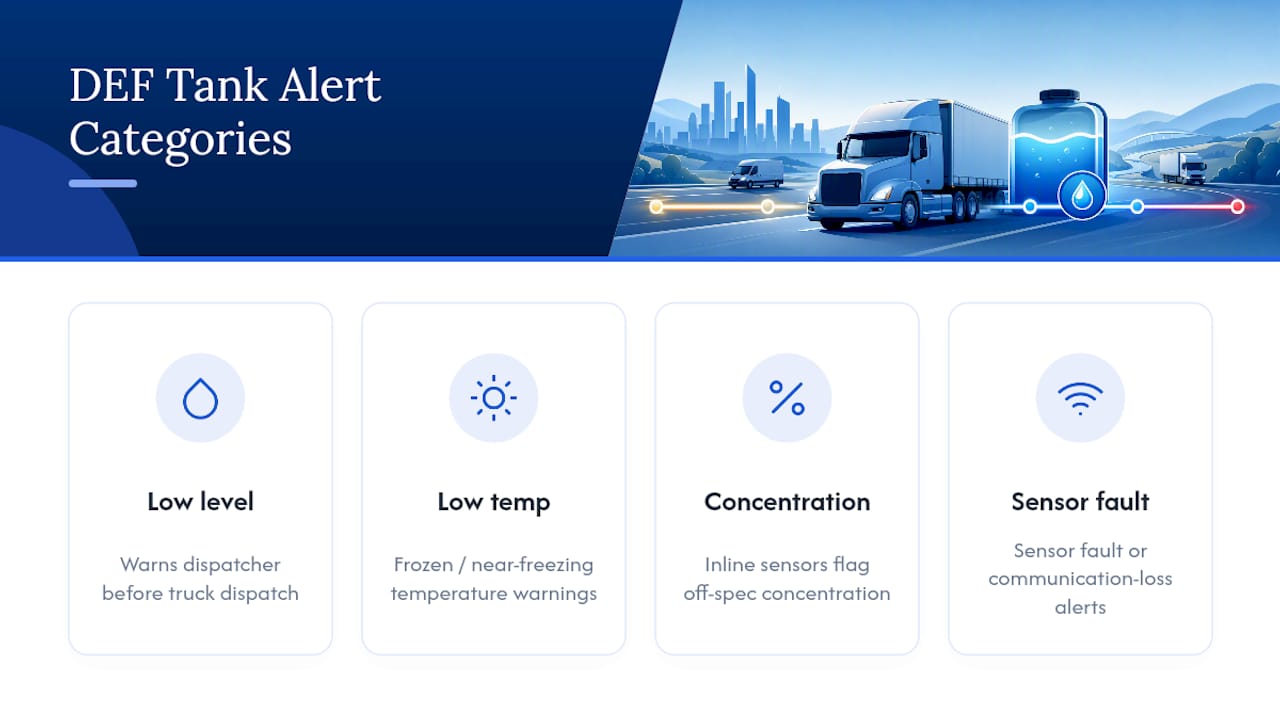
Standard alert categories worth wiring into any system include low level warnings, frozen or near-freezing temperature warnings, off-spec concentration flags from inline quality sensors, and sensor fault or communication-loss alerts
Some depots pair alerts with automated dispenser lockouts, cutting off pump flow when concentration drifts out of spec rather than letting bad fluid go into a tank. That’s a safe default, not overkill.
Feed level and quality data into your telematics or CMMS platform so maintenance scheduling and fuel planning share the same numbers. To cut down on false alarms, give new sensors a warm-up cycle before trusting readings, double-check wiring connections after any service work, and purge air from lines after replacing a probe.
Troubleshooting and Routine Maintenance for DEF Monitoring Systems
Bad-sensor symptoms usually show up as a gauge stuck at empty or full, a persistent low-DEF warning despite a visibly full tank, or an SCR fault code with no obvious mechanical cause. Before you assume the sensor failed, work through it in order:
- Check the DEF quality first with a refractometer. Contaminated or off-spec DEF causes more apparent “sensor failures” than actual hardware defects.
- Inspect wiring and connectors for corrosion or loose pins, since this is a common source of intermittent faults.
- Confirm the sensor’s diagnostic time against OEM specs. A vehicle-level sensor swap typically requires a short labor time consistent with OEM diagnostic specifications.
- If replacement is needed, purge trapped air from the supply line afterward. Skipping this step is a known cause of immediate fault codes on a brand-new sensor.
- Escalate to OEM or authorized service if fault codes persist after a confirmed-good DEF sample and clean wiring.
Pro Tip: Keep a log of every sensor’s model number and connector type. A Heavy Duty Journal troubleshooting review notes that connector mismatches, not sensor defects, cause a fair share of repeat visits.
How to Choose a DEF Tank Monitoring Solution for Your Fleet
Match the monitoring type to the actual job. Vehicle UQLS handles onboard diagnostics and can’t be swapped for depot monitoring, and a depot sensor can’t substitute for a mobile refill unit’s own gauge. Most fleets end up running all three in some combination.
When vetting a system, run through this list:
- Material compatibility: 316L stainless and FKM seals on anything touching the fluid
- Accuracy specs stated in percent of full scale, not just a vague “reliable” claim
- Connectivity options that match your yard, cellular where coverage is solid, LoRa where it isn’t
- Alerting that reaches a person, not just a dashboard nobody checks after hours
- Spare-parts availability and service response time from the vendor
Budget for four cost components: the sensor hardware itself, installation labor, any recurring telemetry subscription, and a plan for emergency delivery if the system flags a shortfall. Before signing anything, ask the vendor directly how they handle warranty replacement, what the expected sensor lifespan is under continuous DEF exposure, and whether their gateway integrates with your existing telematics feed. Fleets managing multiple depot sizes may also want to check tank capacity guidance to size sensor redundancy correctly.
Turning Monitoring Data Into Action
Sampling with a refractometer before swapping any sensor saves labor and avoids replacing good hardware over a bad batch of fluid. Log every sensor’s model and connector type as you install it, and purge air from the line after any service work. These three habits catch most of the false alarms fleets deal with.
This guide’s DEF quality sensor guide and fleet capacity guide focus on field-level detail to address sensor issues that generic advice may not cover effectively.
Set clear trigger rules ahead of time so an alert turns into action automatically:
| Alert Type | Threshold | Recommended Action |
|---|---|---|
| Low level | 20% remaining | Schedule standard resupply within the week |
| Critical low level | low DEF level | Request expedited delivery promptly to avoid downtime |
| Off-spec concentration | Outside ISO 22241 range | Quarantine tank, resample, do not dispense |
| Sensor fault | Communication loss | Verify wiring and DEF quality before replacing hardware |
When your monitoring shows a critical low level or an unplanned outage risk, scheduling DEF delivery through Anytime Fuel Pros gets fluid on-site before a shortfall turns into a derate.
Sources
- Overview — Urea Quality Level Sensor / OEM diagnostic guidance
- Diesel exhaust fluid (DEF) level sensor for fleet management storage tanks — SensorsONE
- DEF Tank Monitoring — OMNTEC
- EPA emission standards reference guide — heavy-duty highway engines and vehicles