

A DEF SDS is a standardized Safety Data Sheet that documents Diesel Exhaust Fluid’s composition (32.5% urea, 67.5% deionized water), its storage and handling limits, first-aid steps, and spill cleanup procedures. Most DEF SDSs classify the product as non-hazardous, but that doesn’t mean you can skip reading it. Go straight to Sections 4, 6, 7, and 8 for the practical stuff, then check the sources section below for real SDS PDFs to download.
TL;DR:
- Always verify SDS revisions, manufacturer details, and product codes before trusting a DEF SDS, and keep a current, locally saved PDF for emergencies.
- Focus on Sections 4, 6, 7, and 8 to quickly understand first aid, spill containment, storage, and PPE requirements during routine operations.
- Handling a DEF spill involves rapid containment, proper absorbent use, and immediate first aid, with large spills potentially requiring professional cleanup.
- Federal law strictly prohibits tampering with or deleting DEF systems, risking hefty civil penalties, warranty voidance, and increased liability for fleets.
- Regular testing with a refractometer and periodic lab analysis ensure DEF quality, preventing costly engine damage caused by contaminated or degraded fluid.
Table of Contents
- Where to Find a Genuine DEF SDS Explained by the Manufacturer
- How to Read an SDS Fast: Sections 4, 6, 7, and 8 First
- DEF Hazard Classification and the Legal Line You Cannot Cross
- Storage Rules, Freezing Point, and Container Compatibility for DEF
- Spill Response and First Aid: What to Do in the First Five Minutes
- Field and Lab Testing: How to Catch Bad DEF Before It Hits the Tank
- Turning an SDS Into a Job-Site Checklist Your Crew Will Actually Use
- When It’s Time to Call for Bulk DEF Delivery
- Sources
Where to Find a Genuine DEF SDS Explained by the Manufacturer
The safest place to get a DEF SDS is straight from the manufacturer or the supplier who fills your tanks. Every major DEF producer, from packaged jug brands to bulk suppliers, posts current SDS PDFs on their own websites, typically under a “resources,” “safety,” or “support” tab. Large fuel and lubricant distributors also maintain SDS libraries covering dozens of products, including DEF, searchable by product name or SDS number.
Skip the third-party SDS aggregator sites when you can. Plenty of them host outdated versions, scanned copies with missing pages, or SDSs for a formulation that doesn’t match what’s actually in your tank. If a bulk delivery truck shows up with fluid from a different manufacturer than your last fill, the SDS on file at your shop may no longer describe what’s in the tank.
Chemical manufacturers and distributors also list CHEMTREC as their after-hours emergency contact on most DEF SDSs, giving responders a 24-hour number to call for exposure or transport incidents. That number belongs on your emergency board next to the fire extinguisher, not buried on page nine of a PDF nobody has opened since it was filed.
Before you trust any SDS you download, run it through a short verification pass:
- Check the revision date on the cover page. OSHA expects employers to keep the most current version on hand, and a document more than a couple of years old is worth double-checking against the manufacturer’s current site.
- Confirm the manufacturer name and contact information match the actual brand of DEF in your tank, not a generic template.
- Look for an SDS number or product code and compare it against the label on your last delivery ticket or tote.
- Verify the SDS follows the 16-section format required under OSHA’s Hazard Communication Standard. A sheet missing sections or using an old MSDS layout from before 2012 is outdated.
- Save a PDF copy locally instead of only bookmarking a link. Manufacturer sites reorganize, and a dead link during an incident review is a bad time to find out.
If your fleet buys from multiple sources throughout the year, keep a binder (physical or digital) with one current SDS per product per supplier. It sounds tedious until an inspector or an insurance adjuster asks for it, and you can hand over the right document in ten seconds instead of scrambling through inboxes.
How to Read an SDS Fast: Sections 4, 6, 7, and 8 First
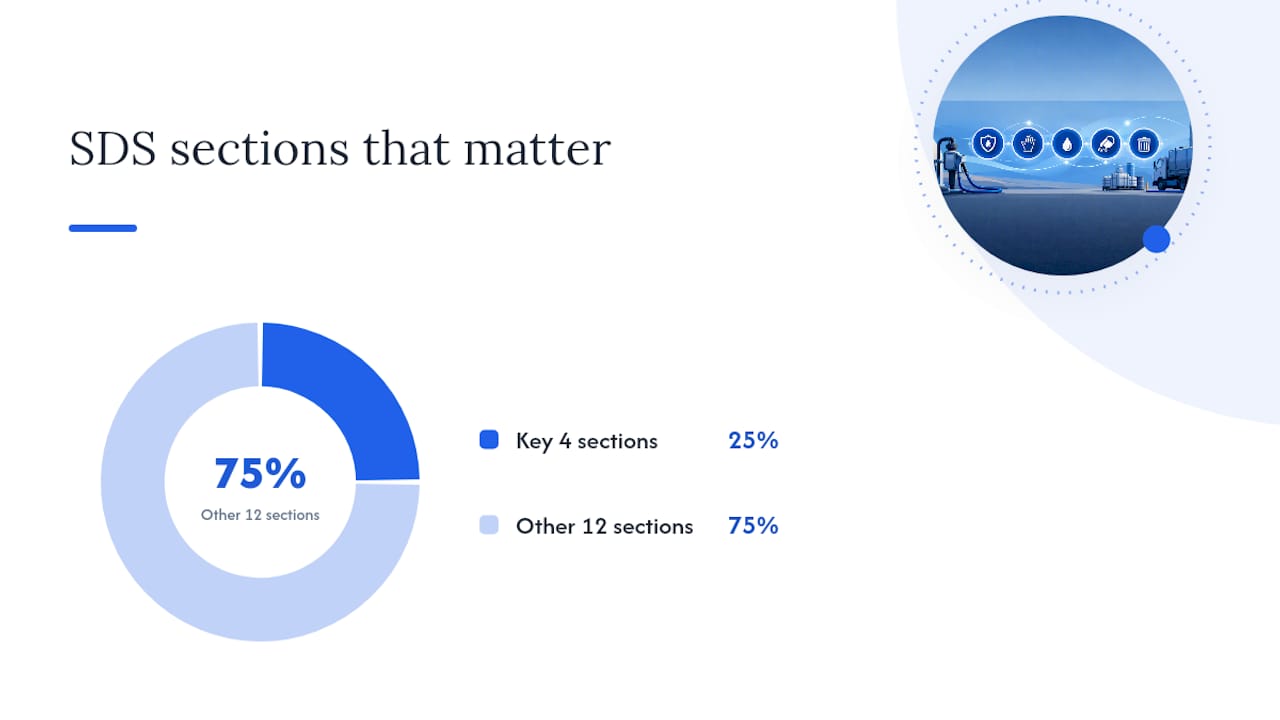
A full Safety Data Sheet runs 16 sections, and almost none of them matter in the middle of a spill. The format is set by OSHA’s Hazard Communication Standard, which means every DEF SDS you’ll ever open follows the same skeleton: identification, hazards, composition, first aid, firefighting, accidental release, handling and storage, exposure controls, physical properties, stability, toxicology, ecology, disposal, transport, regulatory information, and other information.
For day-to-day fleet operations, four sections carry almost all the useful weight.
- Section 4, First Aid Measures. This tells you exactly what to do for skin contact, eye contact, inhalation, and ingestion. DEF is generally mild, but the SDS still lists specific rinse times and when to seek medical attention, and that specificity is what you want written down, not remembered under stress.
- Section 6, Accidental Release Measures. This covers spill containment, recommended absorbent materials, and whether the spill needs to be kept out of storm drains or waterways. Most SDSs are blunt here: DEF is not classified as an environmental hazard, but urea runoff can still affect nearby waterways, so containment still matters.
- Section 7, Handling and Storage. This is where you’ll find temperature ranges, container recommendations, and ventilation notes. It’s also usually where compatible and incompatible materials show up, which matters more than most crews realize.
- Section 8, Exposure Controls / Personal Protection. This lists the PPE the manufacturer recommends, typically safety glasses and gloves for routine handling, sometimes more for large-volume transfer work.
Look for specific phrasing when you scan these sections. Section 4 will usually say something like “flush with water for at least 15 minutes” for eye contact. Section 6 will name an absorbent type, often something as simple as sand or an inert absorbent material, and will specify not to let the spill enter drains. Section 8 will name the PPE explicitly rather than saying “appropriate protection,” and if it doesn’t, that’s a sign you’re looking at a thin or generic SDS.
Pro Tip: Pull the exact wording from Sections 4, 6, 7, and 8 and copy it onto a laminated index card, one card per product, and clip it inside the cab or mount it near the storage tank. Nobody needs to open a 12-page PDF during an actual spill, and a laminated card survives a lot more abuse than a binder.
Training practical guidance from OSHA’s own Hazard Communication material backs this up directly: SDS language is written for regulatory completeness, not speed of use, so mapping it onto site procedures ahead of time is what actually makes it useful in the moment.
DEF Hazard Classification and the Legal Line You Cannot Cross
DEF itself is about as low-risk as industrial fluids get. Because it’s 32.5% high-purity urea and 67.5% deionized water, most manufacturer SDSs classify it as a non-hazardous mixture with no GHS pictograms or signal words required for the product as supplied. That’s a meaningfully different risk profile than diesel fuel or DEF’s own precursor chemicals, and it’s why DEF handling training tends to be lighter than fuel-handling training.
That doesn’t mean zero risk. Some SDS formulations still note mild skin or eye irritation on direct or prolonged contact, and a few list minor respiratory irritation if DEF vapor or mist is inhaled in an enclosed space for an extended period. Basic controls cover almost all of it: safety glasses, gloves for bulk transfer, decent ventilation around dispensing equipment, and a rinse station or eyewash nearby for tank rooms.
The regulatory reality: removing or disabling a vehicle’s DEF system remains a federal violation under the Clean Air Act, regardless of state emissions testing rules, and enforcement runs through EPA civil penalties rather than local inspection stations.
This is the part of DEF safety that has nothing to do with chemistry and everything to do with federal law. Tampering with or deleting a diesel vehicle’s SCR/DEF system is prohibited under the Clean Air Act, and EPA treats it as an emissions-control tampering violation, not a gray area. State-level inspection programs don’t override this: a truck can pass a state emissions check and still be in violation of federal tampering rules if the DEF system has been bypassed. Civil penalties for tampering violations can run into the thousands of dollars per vehicle, per violation, and manufacturers routinely void powertrain warranties once a delete is discovered during service or diagnostic work.
For a fleet, this is a straightforward business risk on top of the legal one. A deleted DEF system tanks resale value, kills warranty coverage, and puts the fleet on the hook if EPA or a state environmental agency ever audits vehicle records. None of that shows up on the SDS itself, but every fleet manager reading one should understand where the actual liability lives.
Storage Rules, Freezing Point, and Container Compatibility for DEF
DEF freezes at roughly 12°F, and that surprises a lot of people who assume “fluid in a tank” behaves like water. It doesn’t ruin the product. Frozen DEF thaws back to its original 32.5% concentration and full performance once it warms up, so a hard freeze overnight isn’t a crisis as long as you give it time to thaw evenly before use.
Shelf life is where temperature does real damage, and heat is a much bigger threat than cold. General storage guidance, drawn from ISO 22241 quality limits and widely used industry charts, indicates that DEF’s shelf life varies considerably with temperature: cooler storage extends stability for multiple months to years, while higher temperatures especially combined with direct sun exposure can accelerate degradation and significantly reduce shelf life.
That’s why an outdoor bulk tank baking in a Texas parking lot in July needs a different sampling schedule than a shaded indoor tote. If your storage location runs hot for months at a time, check concentration more often, not less. Reviewing DEF storage temperature requirements against your actual site conditions is worth doing once a year, not once when you set up the tank.
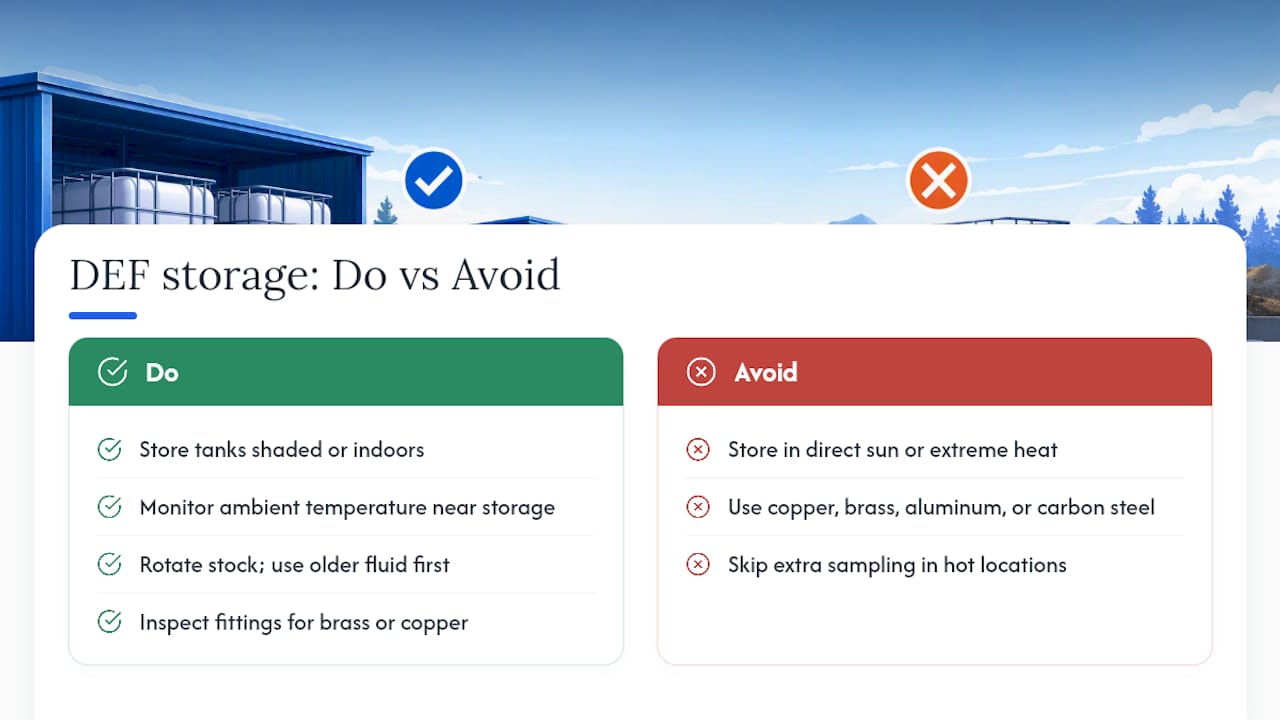
Container material matters as much as temperature. DEF is compatible with high-density polyethylene (HDPE) and stainless steel, which is why virtually every tote, drum, and bulk tank on the market is built from one or the other. It is not compatible with copper, brass, aluminum, or carbon steel. Those metals react with urea over time, degrading the fluid and introducing contamination that can damage an SCR system downstream. If a fitting, pump, or hose assembly on your dispensing setup uses any of those metals, replace it before it becomes an expensive problem.
Pro Tip: Walk your dispensing line once a year and physically check every fitting, not just the tank. Brass hose-end connectors show up more often than you’d expect on retrofitted equipment, and they’re an easy thing to miss when everyone’s focused on the tank material itself.
Practical storage controls that actually hold up over a full season: keep tanks shaded or indoors where possible, monitor ambient temperature near the storage area rather than assuming it matches the forecast, and rotate stock so older fluid gets used before it ages out. A DEF storage compliance checklist built around temperature bands and material compatibility turns all of this into something a new hire can follow without needing the full backstory.
Spill Response and First Aid: What to Do in the First Five Minutes
Move fast on containment before the spill spreads, but move faster on people if anyone’s been exposed. DEF spills are rarely dangerous, but the SDS still spells out a clear sequence, and following it in order keeps a minor incident from turning into a bigger one.
- Address exposure first. For skin contact, remove contaminated clothing and rinse the area with water. For eye contact, flush with water for at least 15 minutes and seek medical evaluation if irritation persists. For inhalation in a poorly ventilated space, move the person to fresh air immediately. For ingestion, don’t induce vomiting; get medical attention.
- Contain the spill before it spreads. Use an inert absorbent material, sand, or an SDS-recommended absorbent product, and keep the fluid away from storm drains, ditches, or any waterway access point.
- Clean up and bag the waste. Scoop or sweep saturated absorbent into a labeled container. DEF residue isn’t classified as hazardous waste in most jurisdictions, but check local disposal rules before assuming that applies to your site, particularly if the spill mixed with fuel, oil, or other chemicals on the ground.
- Decide whether to escalate. A small spill in a contained shop area is a cleanup job. A larger spill that reaches soil, a waterway, or a storm drain may require notifying a state or local environmental agency, and a spill involving injury needs a call to CHEMTREC or your facility’s emergency line, whichever your SDS lists.
- Document it. Note the time, volume, location, response actions taken, and who was involved. This matters for insurance, for OSHA recordkeeping, and for spotting patterns if the same tank or fitting keeps failing.
Large spills that reach soil or groundwater sometimes require professional remediation and licensed disposal of contaminated material, and firms that specialize in hazardous and liquid waste removal can handle that scale of cleanup properly rather than improvising with shop rags and a dumpster. For sites without an internal safety team, having a rapid-response process mapped out ahead of time, similar to the structured playbooks used in emergency operational response for other industrial fluids, keeps a spill from turning into a multi-day cleanup because nobody knew who to call first.
Full storage and handling precautions, including PPE recommendations and dispensing equipment guidance, are covered in more depth in a DEF storage and handling guide worth keeping bookmarked next to your SDS binder.
Field and Lab Testing: How to Catch Bad DEF Before It Hits the Tank
A cloudy jug or an off-color tote is your first warning sign, and it’s one most crews learn to spot on sight after a bad experience. DEF should be clear and colorless. Cloudiness, visible particles, a yellow tint, or a sediment layer at the bottom of a container usually means contamination, degradation from heat exposure, or a fluid that’s simply too old to trust. None of those symptoms guarantee a problem, but all of them are reason enough to test before you pour.
A handheld refractometer is the fastest way to confirm concentration in the field. It reads the refractive index of a small fluid sample and converts that into an approximate urea percentage, letting you check whether a tote or tank is holding close to the 32.5% target. Refractometers are standard equipment across the DEF supply chain for exactly this reason: they’re cheap, fast, and don’t require a lab.
Field check baseline: a properly formulated DEF sample should read within a tight tolerance band around 32.5% urea concentration. A reading noticeably outside that range signals dilution, evaporation, or contamination, and the fluid shouldn’t go into an SCR system until it’s confirmed.
When a refractometer reading looks off, or when you’re qualifying a new bulk supplier for the first time, lab testing under ISO 22241-2 is the next step. Those lab methods check for things a field refractometer can’t catch: biuret levels, aldehyde content, and insoluble matter, all of which can damage SCR components even when the urea concentration itself looks fine.
Build a simple routine around this instead of testing only when something looks wrong:
- Refractometer-check every new delivery before it goes into a bulk tank, especially from a new supplier.
- Retest stored fluid every few months in hot climates, less often in consistently cool storage.
- Send a lab sample for full ISO 22241-2 testing any time you’re qualifying a new supplier or after any incident that suggests contamination.
- Log every test result with the date, source, and reading, so a pattern of bad batches from one supplier shows up fast instead of getting lost in memory.
If contamination does slip through into an SCR system, the downstream symptoms show up in the engine long before anyone traces it back to the fluid. A DEF contamination symptoms guide walks through what those engine-side warning signs look like and how to connect them back to a bad batch.
Turning an SDS Into a Job-Site Checklist Your Crew Will Actually Use
An SDS on a shared drive doesn’t help anyone in the moment they need it. What helps is a one-page checklist mapped to the sections that matter, kept somewhere a tech can grab it without hunting.
Build the checklist around six items pulled straight from the SDS:
- Revision date confirmed current and matching your fluid’s manufacturer
- Section 4 first-aid steps copied verbatim for skin, eye, inhalation, and ingestion exposure
- Section 6 spill containment steps, including the specific absorbent material named
- Section 7 storage temperature range and container material requirements
- Section 8 PPE list, written out rather than paraphrased
- Sample testing procedure and frequency for your specific storage setup
Annotating the actual manufacturer PDF works better than rewriting it from scratch. Highlight Sections 4, 6, 7, and 8 in four different colors, add sticky tabs on those pages, and keep both the annotated PDF and a printed copy in the same binder as your storage compliance records.
| Checklist Item | Pulled From | Where It Lives On-Site |
|---|---|---|
| Revision date and manufacturer match | SDS cover page | Binder + digital archive |
| First-aid steps (skin, eye, inhalation, ingestion) | Section 4 | Laminated card, cab and tank room |
| Spill containment and absorbent type | Section 6 | Laminated card, spill kit location |
| Storage temperature and container material | Section 7 | Posted near bulk tank |
| PPE requirements | Section 8 | Posted at dispensing station |
| Refractometer testing cadence | Field procedure | Logbook near tank |
Once the checklist is built, laminate it and mount it in two places: inside the vehicle bay where DEF gets dispensed, and next to the bulk tank itself. A card that survives grease, weather, and getting knocked off a shelf a dozen times is worth more than a perfectly formatted PDF nobody opens.
When It’s Time to Call for Bulk DEF Delivery
Reading the SDS and running field tests only gets you so far if the tank runs dry mid-shift. A few situations point directly to scheduling delivery instead of scrambling for jugs at a truck stop: a low-tank alarm on a bulk system, a failed refractometer or lab test that means the current supply has to be drained and replaced, or a large job that’s about to burn through your on-hand DEF faster than your normal delivery cycle can cover.
The article is designed to help readers learn the chemistry, storage rules, and SDS literacy needed to run a tighter DEF program without guessing. When it’s time to actually move fluid, Anytime Fuel Pros handles both scheduled and emergency delivery, including wet-hosing bulk tanks directly and swapping out totes on job sites where a truck can’t get close to a fixed tank. Scheduled service works well for fleets with predictable consumption; emergency resupply exists for the low-tank alarm that goes off on a Friday afternoon before a big weekend job.
If you’re not sure how much DEF your fleet actually burns through relative to diesel consumption, running the numbers through a DEF calculator before you set a delivery schedule saves you from guessing and overordering or, worse, underordering and derating a truck mid route. Once you know your consumption rate, requesting a quote for scheduled or on-site delivery takes a few minutes and gets a real resupply plan in place instead of a reactive scramble every time a tank runs low.
Sources
The claims in this guide are backed by the following sources, and each one is worth keeping bookmarked for your own reference:
- EPA — Diesel Exhaust Fluid (DEF) Safety Data Sheet guidance
- OSHA — Hazard Communication Standard: Safety Data Sheets
This article is general information, not a substitute for advice from a qualified lawyer. Consult a qualified legal professional about your own circumstances before acting on anything here.