
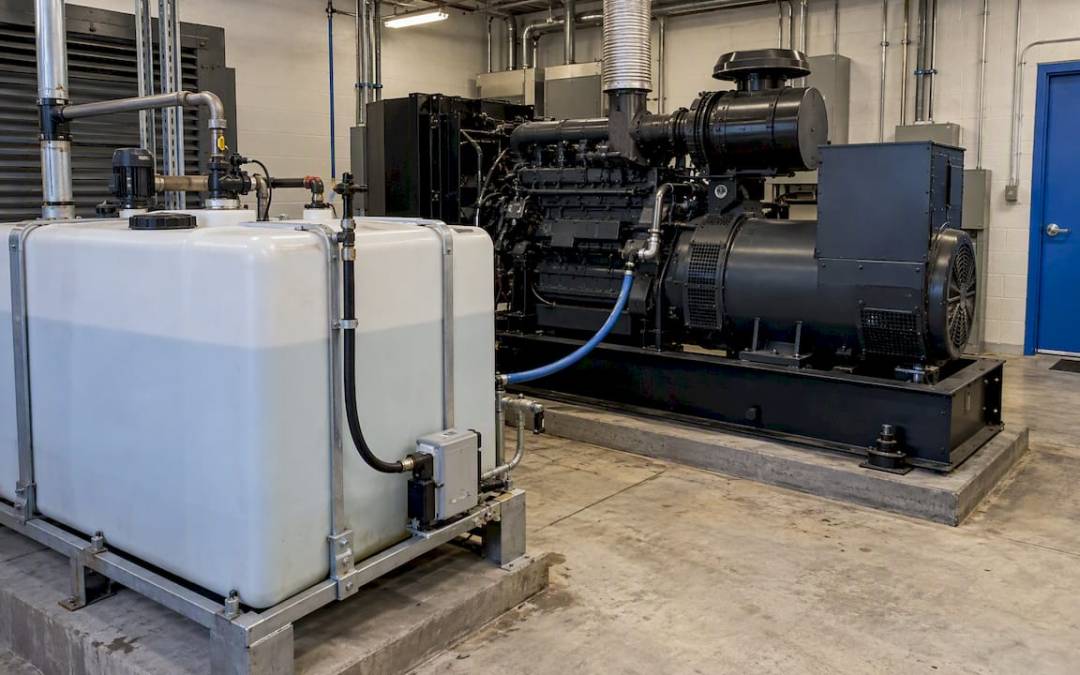
Size DEF for a standby generator from three numbers: how many gallons per hour the engine burns at your expected load, how many hours you must cover without a delivery, and how much usable volume your tank holds. Multiply the first two, add a reserve, and compare the result with the third. Everything else in this guide, from shelf life to freezing, decides whether that math still holds when the outage arrives.
This is not the kW sizing question. Picking the generator’s kilowatt rating is a load and motor-starting exercise. DEF sizing starts after that choice and only applies if your engine has an SCR system, as Tier 4 Final units do.
TL;DR
- DEF use follows load. Cat’s published data for a 2000 ekW standby set shows 1.6 gal/hr at 25% load and 10.1 gal/hr at 100%.
- As a quick planning rule, SCR engines typically dose about 2% of diesel consumption, within a 1% to 5% band depending on the engine’s NOx output.
- Multiply gallons per hour by the runtime you want to cover, then add a reserve. Our worked examples below show how.
- Standby DEF ages and freezes. Plan for a shelf life of about two years, less above 86°F, and for heated tanks and lines where it freezes at 12°F.
- Oversizing the generator can cause light loading and wet stacking, which also distorts your DEF forecast.
Table of Contents
- Why DEF sizing is separate from generator sizing
- Step 1: Find your DEF burn rate
- Step 2: Choose the runtime you must cover
- Step 3: Do the math with worked examples
- Step 4: Add the hours you forget
- Step 5: Match the tank to the site, not just the volume
- Step 6: Build a DEF rotation plan
- Quality: the part that most often breaks the plan
- Sector notes
- Getting DEF delivered to the generator
- Common sizing mistakes
- FAQ
- Sources
Why DEF sizing is separate from generator sizing
A standby generator with SCR injects diesel exhaust fluid into the exhaust stream to cut NOx. If the tank runs dry, the engine controls can derate or stop it, which is the worst possible moment for a standby unit to fail. So the DEF tank is part of your runtime, not an accessory.
The generator’s electrical sizing still matters, because it sets the load, and load drives DEF burn. Clifford Power’s sizing paper warns that oversizing leads to light loading and wet stacking, while undersizing leaves you short of power under load. It also notes that motors can draw 6 to 10 times their rated current when starting, so starting kVA is a real design factor. An oversized set that sits at 20% load will use far less DEF per hour than your nameplate suggests. An undersized set pushed to 100% will use far more.
Before you size DEF, settle the expected load profile: what share of rated kW the site realistically draws during an outage, and whether that changes with HVAC season or cooling demand.

Step 1: Find your DEF burn rate
There are two ways to get gallons per hour. Use the manufacturer’s data when you have it, and the percentage rule when you don’t.
Manufacturer consumption tables
For large Tier 4 Final sets, the spec sheet is the best number you can get. The Cat Clean Emissions Module data for the 3516C HD lists these standby figures:
| Standby rating | DEF at 25% load | DEF at 100% load |
|---|---|---|
| 2000 ekW | 1.6 gal/hr | 10.1 gal/hr |
| 2750 kW | 1.74 gal/hr | 12.62 gal/hr |
Notice the spread. Load moved from a quarter to full and DEF use rose roughly six-fold on the 2000 ekW unit. A single “average” figure hides that, so size against the load case you must survive, not the one you hope for.
The percentage rule
When you only know diesel consumption, a USA-SVC information sheet on DEF with diesel generators puts typical SCR dosing at about 2% of diesel fuel use, ranging from 1% to 5% depending on the engine’s NOx characteristics. Our own planning pages use a more conservative band: our generator DEF consumption guide plans 3 to 5 gallons per 100 gallons of diesel, so you do not run short.

Why plan high? Because the penalty for being wrong is asymmetric. Carrying 20% more DEF than you burn costs you a little storage. Running out costs you the generator.
Step 2: Choose the runtime you must cover
The runtime is a business decision, not a technical one. Ask what the site loses when power is gone, and how long your fuel supplier could realistically take to reach you in a regional event.
Common planning targets:
- Short event cover: 24 hours at full load.
- Extended outage cover: 48 to 72 hours, which matches many fuel-tank sizing policies.
- Resupply-gated cover: enough DEF to run until a scheduled delivery arrives, which depends on your supplier’s lead time.
Write down the number before you look at tank catalogs. Tanks are bought to fit a requirement, and the reverse often ends badly.
Step 3: Do the math with worked examples
The formula is simple:
DEF needed (gal) = burn rate (gal/hr) × runtime (hr) × reserve factor
We use a 1.2 reserve factor in these examples as a planning habit, not a code requirement. Adjust it to your own risk tolerance.
Example A: 2000 ekW unit, 24 hours
Using the Cat figures above:
- At 25% load: 1.6 × 24 = 38.4 gal, or about 46 gal with the reserve.
- At 100% load: 10.1 × 24 = 242.4 gal, or about 291 gal with the reserve.
A tank that comfortably covers the light-load case is nowhere near enough for the full-load case. If your site could hit 100% in a heat wave, size for that.
Example B: 2750 kW unit, 48 hours at full load
12.62 × 48 = 605.76 gal, or about 727 gal with the reserve. This is where a bulk tank or a tote-based plan starts to make sense, and where delivery access matters. If you are weighing formats, our bulk DEF versus totes cost guide compares them.
Example C: Mid-size unit with only diesel data
Say a generator burns 50 gallons of diesel per hour at your expected load. This is an illustrative figure, not a spec:
- At 2%: 1 gal DEF/hr.
- At 5%: 2.5 gal DEF/hr.
Over 72 hours that is 72 to 180 gallons before reserve. The gap between 2% and 5% is large enough that you should ask the engine maker for the actual rate rather than assume.
If you would rather not run the arithmetic by hand, our DEF calculator does it for you.
Step 4: Add the hours you forget
Outage runtime is only part of the annual picture. Standby sets also run for testing, maintenance and sometimes grid support.
Exercise and test runs
Most sites exercise their generators on a schedule. Those runs are usually at low load, so they burn little DEF, but they add up and they keep the SCR system active. Pull your actual run log rather than guessing.
Non-emergency operation
The EPA’s fact sheet on backup generator use explains that emergency engines may run up to 50 hours per year in certain non-emergency situations, including supplying power under a financial arrangement with another entity when listed conditions are met. If your site takes part in demand response or peak shaving, count those hours. For the 2000 ekW example at 100% load, 50 hours is 505 gallons of DEF (10.1 × 50), a figure your emergency-only budget would miss.
Check the conditions with your environmental compliance contact or air permit before counting on those hours. The rules for your unit depend on how it is classified and permitted.
Track your hours properly
A reliable hours-and-load log makes next year’s forecast far better. If you already collect site load readings, half-hourly energy data shows how batteries and generators dispatch against demand, which helps you judge how many hours a generator really runs at what load.
Step 5: Match the tank to the site, not just the volume
A tank that is big enough on paper can still fail in practice.
Materials
DEF is corrosive to carbon steel, aluminum, copper and zinc, according to the USA-SVC sheet. Tanks, pumps and fittings should be made of ISO 22241-compatible materials, typically high-density polyethylene or stainless steel. Our compatible materials checklist walks through what to verify before you connect anything.
Freezing
DEF freezes at 12°F (-11°C) and expands by about 7%, per the same source. Two consequences for outdoor enclosures in cold regions: do not fill tanks to the brim, and make sure the tank and supply lines have heating, so liquid DEF is available the moment the engine starts. Frozen DEF thaws and is usable again, but a standby unit has no time to wait.
Heat and shelf life
Standby DEF has a shelf life of about two years, shorter above 86°F (30°C) or in direct sunlight, per the same sheet. An enclosure in a hot climate can exceed that threshold easily. For sites in Texas or the Southwest, check enclosure temperature in summer. Our DEF storage temperature guide and shelf life guide give working limits.
Access
Clifford Power notes that the generator should be placed so technicians and fuel delivery vehicles can reach it easily and safely. That applies to the DEF tank too. If a delivery truck can’t get a hose to the tank during a storm, your calculated runtime is theoretical.
Step 6: Build a DEF rotation plan
A generator that rarely runs can hold DEF for a long time. The risk is not running out, it’s using aged or degraded fluid. The USA-SVC sheet warns that idle generators need a proactive DEF management plan, or the fluid can degrade and urea can crystallize in the injection system.
A practical routine:
- Record the date and batch of every DEF fill on the tank.
- Check tank level and temperature exposure at each scheduled exercise.
- Test concentration if the fluid has been stored warm or for a long time. A refractometer reading should match 32.5% urea. Our DEF quality sensor fault guide explains how to test before replacing parts.
- Replace or top off before the fluid approaches two years old.
- Reorder when you reach a set reserve level, not when the gauge looks low.
Quality: the part that most often breaks the plan
The same USA-SVC sheet stresses that DEF quality must meet ISO 22241, and that buying bulk DEF from a reputable, API-certified supplier helps you avoid contaminants that cause SCR malfunctions and derates. A big tank of off-spec fluid is worse than a small tank of good fluid. Read our ISO 22241 basics for fleet professionals and, if you buy under contract, the ISO 22241 fleet procurement guide.
Ask any supplier for lot documentation, how they store and transfer DEF, and what they use for dedicated hoses.
Sector notes
Different operations size DEF differently:
- Data centers commonly carry more generators, longer runtime targets and audit pressure. See our data center generator DEF planning guide for the 3% to 5% planning approach.
- Events and temporary power use rental sets for short, heavy-load periods. Our event generator DEF guide covers how crews avoid derates.
- Texas sites can look at our San Antonio generator DEF planning page for permit and SCR protection planning.
Getting DEF delivered to the generator
Once you know your volume, the next question is how it reaches the tank. Options include totes, drums, and bulk delivery with a metered hose to the tank. Our guide to types of DEF delivery services explains the differences, and bulk DEF delivery scheduling tips help you set a refill cadence that matches your reserve level.
Request a quote for your site
DEFsales.com is an information resource and does not sell DEF directly. Anytime Fuel Pros is the commercial supplier we point readers to for bulk and on-site DEF delivery. When you have your gallons-per-hour figure, runtime target and tank size, take them to our DEF delivery and bulk diesel guide and request a delivery quote. The more precisely you describe the unit and tank access, the more accurate the plan.
Common sizing mistakes
- Sizing DEF to the average load. Plan for the load case you cannot afford to fail.
- Ignoring the generator’s real load. Oversized units run lightly, so the engine and your forecast both suffer.
- Forgetting non-emergency hours. Include up to 50 hours of permitted non-emergency use if your site does it.
- Skipping heating and freeze allowance. Cold-region enclosures need heated lines and headroom in the tank.
- Treating DEF as a one-time fill. It ages, so rotate it.
- Using the wrong materials. Carbon steel or copper fittings can contaminate the fluid.
FAQ
How much DEF does a standby generator use?
It depends on engine size and load. Cat’s data for a 2000 ekW standby set shows 1.6 gal/hr at 25% load and 10.1 gal/hr at 100%. As a rule of thumb, SCR engines dose roughly 2% of diesel consumption, with a range of 1% to 5%. Use the manufacturer’s data for your model whenever you can.
How long can DEF sit in a standby generator tank?
About two years in good conditions, according to the USA-SVC sheet. Heat above 86°F (30°C) and direct sunlight shorten that. Log fill dates and test concentration if the fluid has been stored warm.
Does DEF freeze in an outdoor generator enclosure?
Yes, at 12°F (-11°C), and it expands by about 7% when it does. Cold-climate units need heated tanks and lines and should not be filled to capacity. Ask your generator dealer how your model handles heating.
Do I count test runs and demand-response hours in my DEF plan?
Count both. Test runs are usually short and light, but demand-response or other non-emergency hours can be much larger, up to 50 hours a year under the EPA provisions described above when conditions are met. Confirm the details against your air permit.
Sources
- Cat Clean Emissions Module for 3516C HD, Tier 4 Final
- Diesel Exhaust Fluid (DEF) Emissions with Diesel Generator Systems, USA-SVC
- Sizing and Specifying Rental Generator Sets, Clifford Power
- EPA Fact Sheet and FAQ: Use of Backup Generators