
Diesel Exhaust Fluid — commonly known as DEF — is one of the most misunderstood requirements in modern diesel engine operation. Every diesel engine manufactured after 2010 in the United States requires it. Run out and your engine will eventually shut down. Use the wrong product and you risk thousands of dollars in SCR system damage. Yet most operators have only a vague understanding of what DEF actually is, why it exists, and how it works. This guide covers everything — from the basic chemistry to the complete SCR process — so you can manage DEF with confidence.
What is Diesel Exhaust Fluid?
Diesel Exhaust Fluid is a non-toxic, non-flammable aqueous urea solution composed of exactly 32.5% high-purity urea and 67.5% deionized water. It is not a fuel additive — it is stored in a completely separate tank on the vehicle or equipment and injected directly into the exhaust stream, never into the fuel system.
DEF is required by all diesel engines equipped with Selective Catalytic Reduction (SCR) technology — the emissions control system mandated by the EPA for all diesel engines meeting Tier 4 Final (non-road) and EPA 2010 (on-road) standards. Without DEF, these engines cannot legally operate and will eventually shut themselves down.
In Europe and Australia, the same fluid is sold under the trademarked name AdBlue. In North America it is called DEF. Both names refer to the identical product — aqueous urea solution 32.5% (AUS 32) meeting ISO 22241 specifications. They are fully interchangeable.
Key fact: DEF is one of the most precisely specified commercial fluids in existence. ISO 22241 sets maximum allowable concentrations for more than a dozen potential contaminants — including individual metals, minerals, and organic compounds. This level of specificity exists because even trace amounts of the wrong contaminant can permanently damage SCR catalyst surfaces worth thousands of dollars.
Why does DEF exist? The emissions backstory
DEF exists because of nitrogen oxides. Diesel engines are highly efficient at converting fuel into power, but that combustion process produces nitrogen oxides (NOx) as a byproduct — a family of gases that contribute to smog, acid rain, and respiratory illness. For decades, diesel engines were among the largest industrial sources of NOx emissions in the United States.
The EPA's Tier 4 standards, phased in between 2008 and 2015, mandated a dramatic reduction in NOx and particulate matter from non-road diesel engines. For on-road trucks, equivalent standards took effect in 2010. Meeting these targets required technology that simply did not exist at scale in diesel engines at the time — and that technology turned out to be Selective Catalytic Reduction.
SCR was already proven in industrial applications — power plants had been using it to clean stack emissions for years. Adapting it to mobile diesel engines required miniaturizing the system and developing a reliable, standardized reagent that could be widely available. That reagent is DEF.
Today, SCR with DEF is the dominant emissions control technology for diesel engines above 25 horsepower in the United States, Europe, Australia, and most major markets worldwide. It is not going away — and for fleet operators and equipment managers, understanding how it works is a fundamental operational competency.
Watch: DEF and SCR explained visually
What is DEF made of?
DEF contains two ingredients — nothing more, nothing less:
- 32.5% high-purity synthetic urea — Urea is a naturally occurring nitrogen compound found in biological systems, but the urea used in DEF is synthetically manufactured to pharmaceutical-grade purity. It is fundamentally different from agricultural urea used as fertilizer — agricultural urea contains biuret and other contaminants that would damage SCR catalysts. Never attempt to make homemade DEF using agricultural urea.
- 67.5% deionized water — The water in DEF is stripped of all dissolved minerals, metals, and ions through a deionization process. Tap water contains calcium, magnesium, chlorides, and other minerals that would deposit inside SCR components and cause damage over time. Only deionized water meets ISO 22241 specifications.
The 32.5% concentration is not arbitrary. It represents the eutectic point of the urea-water solution — the specific ratio at which the mixture has the lowest possible freezing point (12°F / -11°C). Any higher or lower concentration would freeze at a higher temperature, creating operational problems in cold climates.
How does DEF work? The SCR process step by step
The Selective Catalytic Reduction process is what transforms DEF from a liquid in a tank into clean exhaust at the tailpipe. Here is exactly what happens:
The engine produces NOx in the combustion chamber
During diesel combustion, the high temperatures and pressures in the cylinder cause atmospheric nitrogen and oxygen to combine into nitrogen oxides (NOx). The hotter and harder the engine works, the more NOx is produced.
Exhaust gases pass through the diesel particulate filter (DPF)
Before reaching the SCR system, exhaust passes through the DPF, which captures soot and particulate matter. The DPF addresses the particulate side of diesel emissions — the SCR system handles the NOx side.
The dosing system injects DEF into the exhaust stream
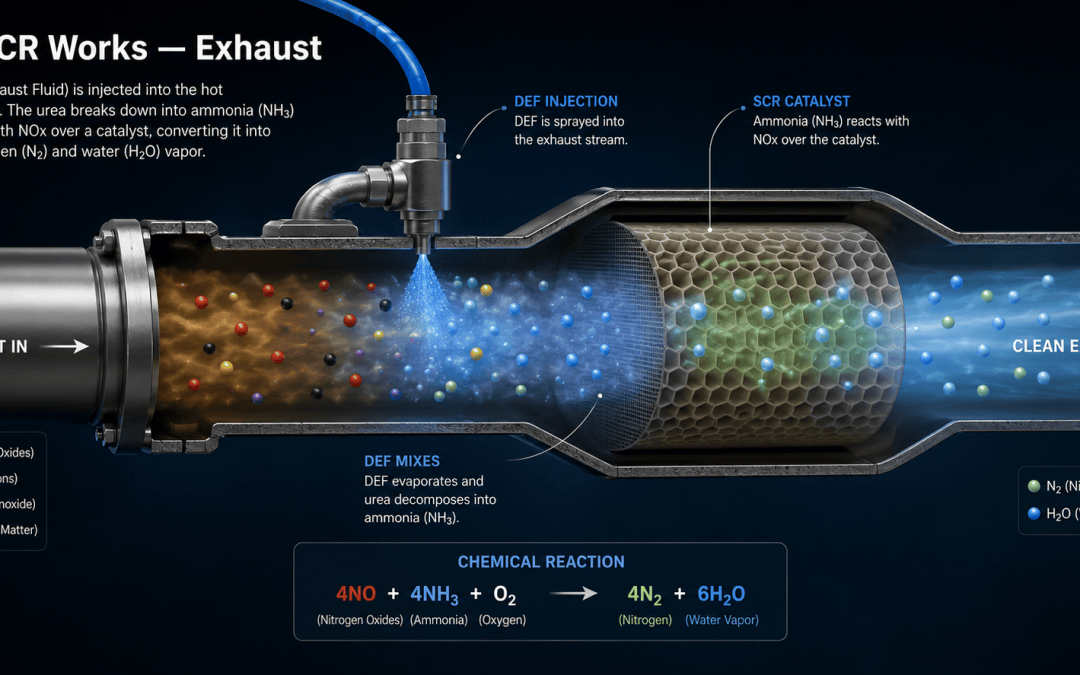
A precision dosing injector sprays a fine mist of DEF into the hot exhaust gases downstream of the DPF. The dosing control unit (DCU) calculates exactly how much DEF to inject based on real-time NOx sensor readings, exhaust temperature, and engine load data from the ECU.
DEF decomposes into ammonia
The heat of the exhaust stream causes the urea in DEF to undergo thermolysis and hydrolysis — breaking down into ammonia (NH₃) and carbon dioxide (CO₂). It is the ammonia that is the active reducing agent in the next step.
Ammonia reacts with NOx in the SCR catalyst
The ammonia-laden exhaust gas enters the SCR catalyst — a honeycomb structure coated with catalytic material, typically vanadium or zeolite-based. In the catalyst, ammonia reacts selectively with NOx molecules in a reduction reaction, converting them into harmless diatomic nitrogen (N₂) and water vapor (H₂O).
Clean exhaust exits the tailpipe
The treated exhaust — now composed primarily of nitrogen, water vapor, and CO₂ — exits through the tailpipe. A properly functioning SCR system reduces NOx emissions by up to 90%, enabling compliance with EPA Tier 4 Final and Euro 6 standards.
The DEF fail-safe system: what happens when you run out
Every SCR-equipped diesel engine sold in the United States includes an EPA-mandated progressive fail-safe system that activates as DEF levels drop. This system exists to make it economically impractical to operate without DEF — ensuring continuous emissions compliance.
The sequence is straightforward: at approximately 10% DEF remaining, a warning light activates. As levels continue to fall, engine power is progressively reduced — commonly called "limp mode." Once DEF is completely depleted and the engine shuts off, most engines will not restart until DEF is added.
For a detailed breakdown of each stage and how to recover from a limp mode event, see our full guide: What happens when your diesel engine runs out of DEF — limp mode explained.
How much DEF does a diesel engine consume?
DEF consumption is proportional to diesel fuel usage — specifically, it runs at approximately 2–5% of diesel consumption depending on engine load, equipment type, and duty cycle. A fleet burning 10,000 gallons of diesel per month will consume approximately 200–500 gallons of DEF over the same period.
For most mixed-use commercial fleets, 3% is a reliable planning figure. Highway-dominant operations typically run closer to 2%, while construction and mining equipment under sustained high load may approach 5%.
Use our DEF consumption calculator to get a precise estimate for your fleet based on your actual diesel usage and duty cycle.
DEF quality and why ISO 22241 matters
Not all DEF is created equal — and the consequences of using off-spec DEF are severe. ISO 22241 is the international standard that defines DEF composition, testing methods, handling requirements, and dispensing specifications. Using DEF outside these specifications can cause permanent SCR catalyst damage, injector failure, and EPA compliance violations — regardless of whether the tank shows as full.
Always source DEF from suppliers who can provide ISO 22241 certification documentation with every delivery. For bulk DEF delivery services, this means requesting a certificate of analysis (COA) confirming the product meets specification. For more detail, read our full guide: What is ISO 22241 and why does DEF quality matter?
Key DEF facts for operators
- DEF is 32.5% urea + 67.5% deionized water — ISO 22241 certified
- Never add DEF to the diesel tank — it goes in a separate dedicated tank
- DEF freezes at 12°F but recovers completely after thawing
- Running out of DEF triggers limp mode and eventually prevents engine restart
- Off-spec DEF can permanently damage SCR catalysts worth $5,000–15,000+
- DEF consumption runs at 2–5% of diesel usage depending on engine load
- Bulk DEF delivery is 60–80% cheaper per gallon than retail jugs
Getting DEF delivered to your fleet or job site
For commercial fleet operators and construction sites consuming more than 50–100 gallons of DEF per month, scheduled bulk DEF delivery is significantly more cost-effective than retail jugs — and eliminates the operational risk of running out between purchases. On-site diesel exhaust fluid delivery brings ISO 22241-certified bulk DEF directly to your fleet yard or job location on a schedule matched to your consumption rate.
If you've been searching for DEF delivery near me for your fleet or operation, Anytime Fuel Pros provides nationwide bulk DEF delivery with same-day and next-day service available in most markets.
Need bulk DEF delivered to your site?
Anytime Fuel Pros delivers ISO 22241-certified bulk Diesel Exhaust Fluid nationwide — to fleet yards, construction sites, and job locations. Same-day and next-day service available. No contracts required.
Request a DEF delivery quote →